













Ming dynasty shipwrecks hide a treasure trove of artifacts in the South China Sea, excavation reveals
Researchers have retrieved hundreds of artifacts, including porcelain items, copper coins and ornate pieces of pottery.
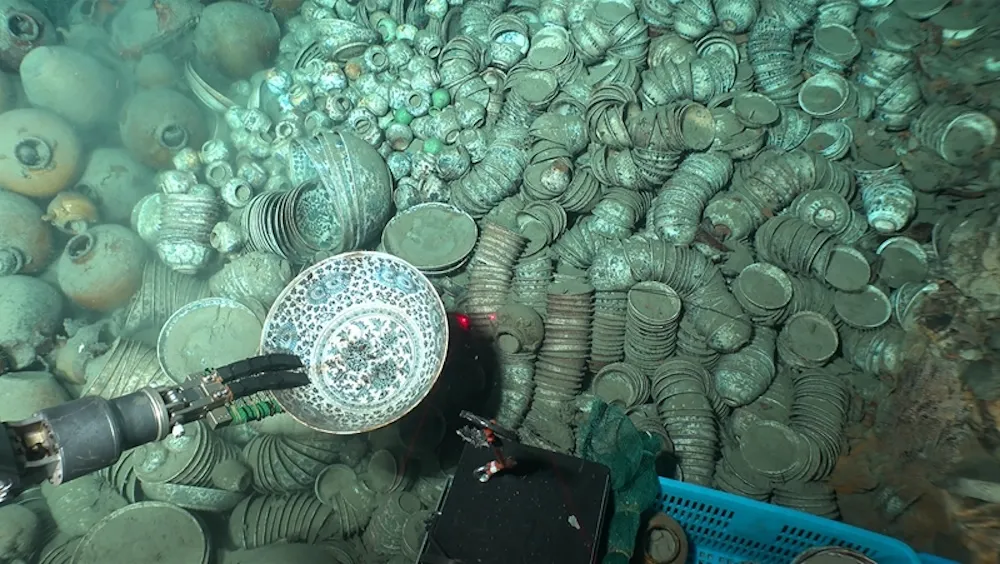
Divers have retrieved more than 900 artifacts from two centuries-old shipwrecks hiding in the depths of the South China Sea.
In October 2022, researchers discovered the shipwrecks around 4,900 feet (1,500 meters) below the surface of the sea, which is bound by China to the north, Vietnam to the west and the Philippines to the east, according to a statement from the Chinese government.
The twin wrecks, which date to the Ming dynasty (1368 to 1644), sit less than a mile (1.5 kilometers) off the coast of Sanya, a city on China's Hainan Island. The sites are about 14 miles (22 km) apart, the South China Morning Post (SCMP) reported.
In 2023, researchers began the arduous task of mapping and excavating the sites using a deep-sea submersible called the "Shenhai Yongshi," or "Deep Sea Warrior," The Guardian reported.
"The wrecks are both relatively well-preserved and a large number of relics have been uncovered," Yan Yalin, director of the archaeology department for China's National Cultural Heritage Administration (NCHA), said at a news conference in 2023.
Related: 13 haunting shipwrecks from the ancient world
Now, researchers have used deep-sea-diving equipment to sift through the wreckage. They uncovered a wealth of porcelain and pottery pieces alongside copper coins at the first shipwreck site, according to the statement.
Get the world’s most fascinating discoveries delivered straight to your inbox.
RELATED STORIES
That vessel's cargo had originated from Jingdezhen, known as China's porcelain capital, the SCMP reported.
The second boat contained 38 artifacts, including lumber, porcelain and pottery items, spiral-shaped turban shells and deer antlers, according to the statement.
Both wrecks highlight the importance of "trade and cultural exchanges along the ancient Maritime Silk Road," Guan Qiang, deputy head of the NCHA, said in the statement.
No details were given about the cause of the shipwrecks.
Jennifer Nalewicki is former Live Science staff writer and Salt Lake City-based journalist whose work has been featured in The New York Times, Smithsonian Magazine, Scientific American, Popular Mechanics and more. She covers several science topics from planet Earth to paleontology and archaeology to health and culture. Prior to freelancing, Jennifer held an Editor role at Time Inc. Jennifer has a bachelor's degree in Journalism from The University of Texas at Austin.