













3,500-year-old burial of Nubian woman reveals 1 of world's earliest known cases of rheumatoid arthritis
Lesions found on the bones of a Nubian skeleton reveal evidence of an ancient rheumatoid arthritis case.
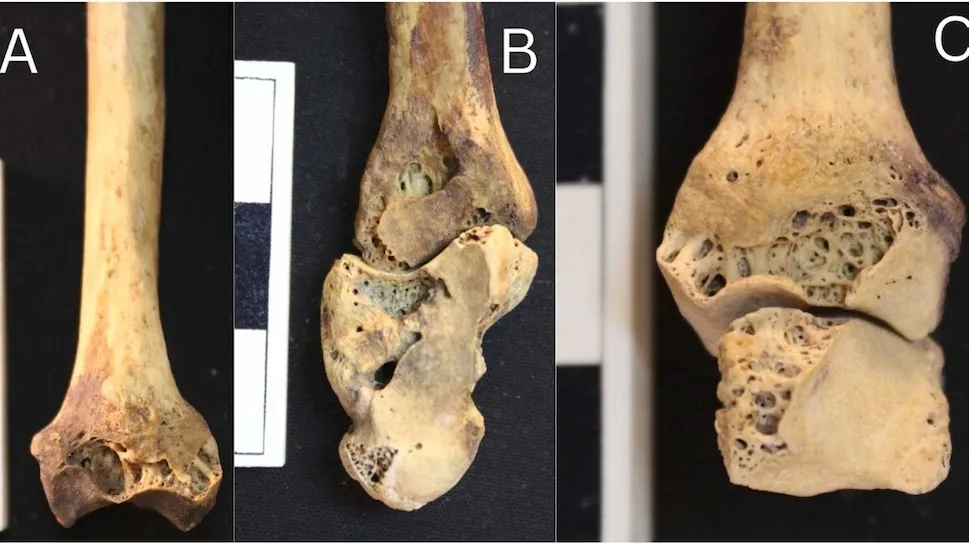
The 3,500-year-old pockmarked skeleton of an ancient Nubian woman could be one of the earliest known cases of rheumatoid arthritis in the world, scientists say.
Archaeologists discovered the woman's skeletal remains in 2018 while conducting excavations at a cemetery located along the bank of the Nile near Aswan, in southern Egypt. Analyses revealed that she would have stood around 5 feet (1.5 meters) tall, been around 25 to 30 years old when she died and lived sometime between 1750 and 1550 B.C. The researchers published their case study in the March issue of the International Journal of Paleopathology.
Because the skeleton was so well preserved and contained most of its bones, including its hands and feet, the researchers were able to conduct a thorough osteological analysis of the remains.
"In many archaeological cases, you don't often get the full skeleton," lead study author Madeleine Mant, an assistant professor in the Department of Anthropology at the University of Toronto in Canada, told Live Science. The woman's well-preserved remains "gave us the chance to look at this disorder that actively attacks the small bones of the hands and feet and talk about it with a little bit more security," she said.
Analyses of the woman's extremities revealed that she likely had rheumatoid arthritis (RA), an autoimmune disorder in which the immune system mistakenly attacks the body's tissues, resulting in inflammation, particularly in the joints. Today, doctors diagnose the condition using a combination of bone imaging and blood tests that look for proteins tied to inflammation and for antibodies trained to attack the body's tissues.
Related: Ancient Egyptian teenager died while giving birth to twins, mummy reveals
Of course, in this case, the scientists could only look at the bones.
Get the world’s most fascinating discoveries delivered straight to your inbox.
"The joint surfaces themselves weren't damaged, and in a lot of other types of arthritis you get destruction where the two bones meet," study co-author Mindy Pitre, an associate professor and chair of anthropology at St. Lawrence University in New York, told Live Science. "In our case we had no destruction of where the bones meet."
Instead, researchers spotted "cavitations or erosive lesions with smoothed-out holes" in the woman's bones, which point to a rheumatoid arthritis diagnosis, Pitre said.
"I'm used to seeing osteoarthritis — it's one of the most common joint conditions that we see archaeologically," Pitre added. "It looks like bone on bone where you get this smooth look that resembles ivory. In rheumatoid, you don't get that whatsoever. The minute I recognized it, I noticed that the lesions didn't look typical."
Nowadays, less than 1% of the adult global population has a diagnosis of this disorder, according to a 2023 study in The Lancet Rheumatology. In contrast, it's estimated that nearly 8% of the global population has osteoarthritis.
"It wouldn't be surprising that, archaeologically speaking, it would be pretty rare to have in ancient Egypt," Pitre said. "Especially since folks weren't living long enough in the past to manifest these types of lesions."
The earliest clinically described cases of RA didn't even occur until thousands of years later in 17th century Europe, with zero mention of the specific illness in ancient Egyptian texts, the authors wrote in the new study. Other RA cases in the archaeological record include 5,500-year-old bones from ancient Egypt and 5,000-year-old human remains from Alabama.
RELATED STORIES
Researchers said that it's hard to know what kind of impact RA had on the day-to-day life of the individual, but she "would have likely experienced a decreased quality of life, especially as the condition progressed," they wrote in the study. The individual was found buried with grave goods, including a leather garment containing beadwork made of ostrich eggshells and stone, a mother-of-pearl bracelet and Nubian and Egyptian pottery fragments.
"This person was likely dealing with a condition that caused swelling, soreness and mobility issues," Mant said. "We have to think about what it would have looked like for somebody living on that landscape during that time."
Jennifer Nalewicki is former Live Science staff writer and Salt Lake City-based journalist whose work has been featured in The New York Times, Smithsonian Magazine, Scientific American, Popular Mechanics and more. She covers several science topics from planet Earth to paleontology and archaeology to health and culture. Prior to freelancing, Jennifer held an Editor role at Time Inc. Jennifer has a bachelor's degree in Journalism from The University of Texas at Austin.