













Antarctica Experiment Discovers Puzzling Space Ray Pattern

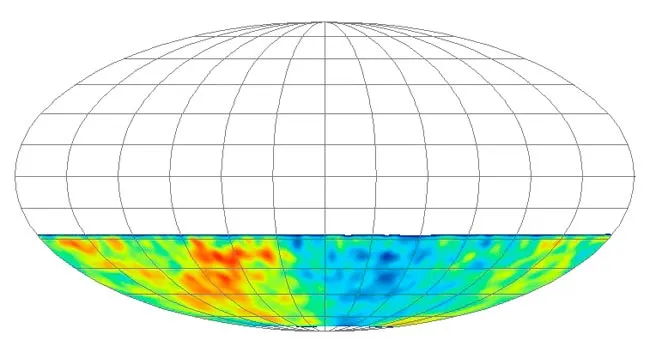
A puzzling pattern in the cosmic rays bombarding Earth from space has been discovered by an experiment buried deep under the ice of Antarctica.
Cosmic rays are highly energetic particles streaming in from space that are thought to originate in the distant remnants of dead stars.
But it turns out these particles are not arriving uniformly from all directions. The new study detected an overabundance of cosmic rays coming from one part of the sky, and a lack of cosmic rays coming from another.
This odd pattern was detected by the IceCube Neutrino Observatory, an experiment still under construction that is actually intended to detect other exotic particles called neutrinos. In fact, scientists have gone out of their way to try to block out all signals from cosmic rays in order to search for the highly elusive neutrinos, which are much harder to find.
Yet in sifting through their cosmic-ray data to try to separate it from possible neutrino signals, the researchers noticed the intriguing pattern.
"IceCube was not built to look at cosmic rays. Cosmic rays are considered background," said University of Wisconsin-Madison researcher Rasha Abbasi in a statement. "However, we have billions of events of background downward cosmic rays that ended up being very exciting."
Previous studies have found a similar lopsidedness (called anisotropy) in the sky over the Northern Hemisphere, but this was the first time scientists saw that the pattern extended to the southern sky visible from Antarctica.
Get the world’s most fascinating discoveries delivered straight to your inbox.
"At the beginning, we didn't know what to expect," Abbasi said. "To see this anisotropy extending to the Southern Hemisphere sky is an additional piece of the puzzle around this enigmatic effect — whether it's due to the magnetic field surrounding us or to the effect of a nearby supernova remnant, we don't know."
One idea to explain the asymmetry is that a star may have recently died in a supernova explosion relatively nearby, and its remnant may be pouring out loads of cosmic rays that would dominate the signals we receive.
Whether or not the mystery gets solved, the observations could help scientists understand more about how cosmic rays are formed in the first place. Growing consensus favors the supernova remnant idea, though the details are not hammered out. Scientists think that the shells around dead stars, made of puffed-out layers of gas that were expelled by the star before it exploded, contain strong magnetic fields that may act as cosmic particle accelerators, speeding up particles to close to the speed of light.
"This is exciting because this effect could be the 'smoking gun' for our long-sought understanding of the source of high-energy cosmic rays," Abbasi said.
IceCube's findings on cosmic rays are detailed in a paper published Aug. 1 in the Astrophysical Journal Letters.
- Toyota Recall Might Be Caused by Cosmic Rays
- Twisted Physics: 7 Recent Mind-Blowing Findings
- Death Rays From Space: How Bad Are They?
