













How a Hangover Affects Your Brain the Next Day

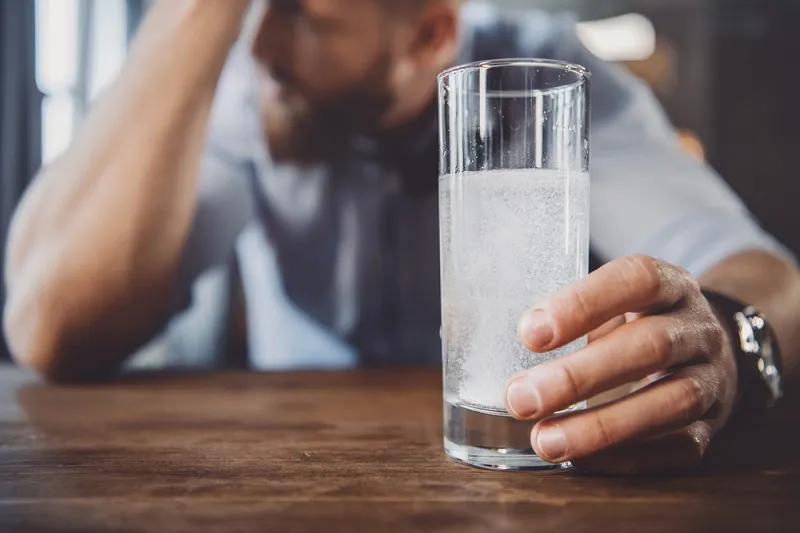
We all know we shouldn't drink and drive. But what about hopping behind the wheel the morning after you've been drinking? According to a new meta-analysis, even this could be problematic, as the effects of alcohol on our brains may linger even after the chemical has left our bloodstream.
The meta-analysis, which was published Aug. 25 in the journal Addiction, found that a night of heavy drinking may affect people's cognition the next day, including their memory, attention, coordination and even driving skills.
"Our findings demonstrate that [having a] hangover can have serious consequences for the performance of everyday activities such as driving, and workplace skills such as concentration and memory," senior study author Sally Adams, an assistant professor in the Department of Psychology at the University of Bath, in the United Kingdom, said in a statement.
Thinking after drinking
It's well-known that drinking alcohol can temporarily impair thinking and coordination while a person is intoxicated. But whether drinking alcohol impairs cognition the next day — i.e., when a person is hungover — is less clear, with studies on the topic finding conflicting results. [11 Interesting Facts About Hangovers]
In the meta-analysis, the researchers analyzed data from 19 previous studies involving more than 1,100 people. All of the studies tested people's thinking abilities the day after they had drunk heavily, when their blood-alcohol level was less than 0.02 percent. (For comparison, the legal blood-alcohol limit for driving a car in the United States is 0.08 percent.)
Some of the studies were conducted in a laboratory — meaning that researchers gave people precise amounts of alcohol before testing their thinking abilities; other studies were "naturalistic," meaning that researchers told people to come to the lab after a typical night of social drinking.
The study found that, overall, people who were hungover had poorer attention, memory and coordination skills, compared with those who weren't hungover. A few of the studies tested people's driving ability using a driving simulation. The studies found that when people were hungover, their ability to control a vehicle was impaired, compared with when they were not hungover.
Get the world’s most fascinating discoveries delivered straight to your inbox.
Although many people think that it's fine to drive the morning after a night of drinking, "it might be that we're still impaired the next day, even after the alcohol has left our system," Adams said.
Overall, the findings suggest that "some of the things that you might expect to happen with your thought processes on alcohol may continue throughout into the hangover period," said lead author Craig Gunn, also of the University of Bath's Department of Psychology. This means that if you're a student attending a lecture, you might not be able to remember things as well when you're hungover, compared with when you're not hungover, Gunn said. And if you're driving a car, you might not be able to react as efficiently to a red light, he said.
Still, the researchers noted that some of the studies did not take into account other factors that could affect thinking abilities, such as smoking or sleep deprivation. The researchers called for further studies testing the effects of alcohol on cognition, particularly on people's "executive functions," which include decision-making and problem solving.
More research is also needed on the effect of hangovers on workplace safety and productivity, the researchers said. They noted that although many workplaces have policies prohibiting intoxication on the job, few of these policies cover the next-day effects of alcohol.
Original article on Live Science.

Rachael is a Live Science contributor, and was a former channel editor and senior writer for Live Science between 2010 and 2022. She has a master's degree in journalism from New York University's Science, Health and Environmental Reporting Program. She also holds a B.S. in molecular biology and an M.S. in biology from the University of California, San Diego. Her work has appeared in Scienceline, The Washington Post and Scientific American.