















Are Supermassive Black Holes Going to Eat the Universe?

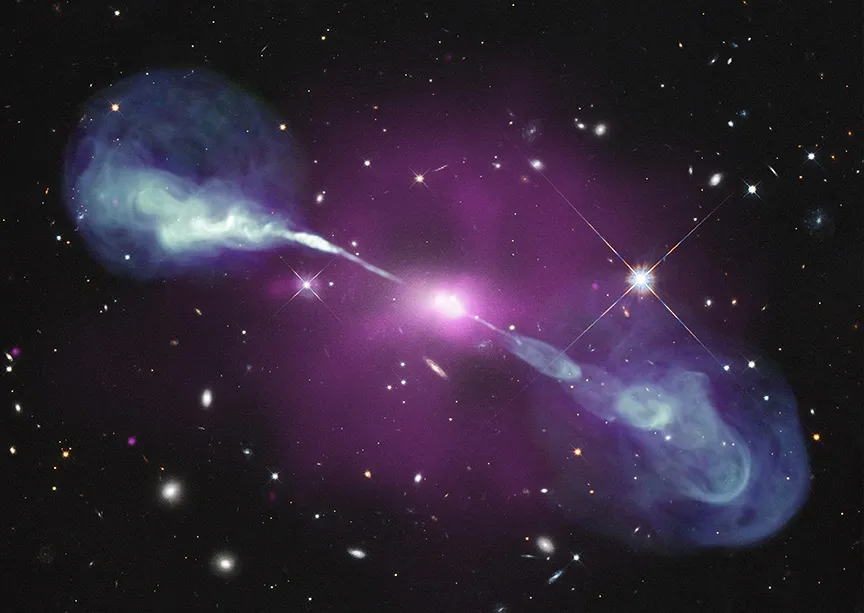
The largest black holes grow faster than their galaxies, according to new research.
Two studies from separate groups of researchers find that so-called supermassive black holes are bigger than astronomers would have calculated from their surroundings alone. Supermassive black holes are enormous gravity wells found in the center of large galaxies.
No stress, though: The black holes are generally no longer growing, and they aren't capable of eating their host galaxies for dinner. [Science Fact or Fiction? The Plausibility of 10 Sci-Fi Concepts]
"The black hole is tiny compared to the whole galaxy, so we are very safe!" said Guang Yang, a graduate student at The Pennsylvania State University who led one of the new studies.
Yang's study found that the larger the galaxy, the faster the black hole grew in comparison to the birth rate of the galaxy's stars. The other study found that the masses of supermassive black holes are about 10 times greater than would be expected if these central black holes grew at the same rate as the galaxies they inhabit.
Galaxies and their black holes
Astronomers are interested in the relationships between black holes and their galaxies for two main reasons. First, if they can calculate the size of one based on another, they can determine, say, the mass of a supermassive black hole even if they can't directly measure it. Second, any constant relationships between the two can help explain the laws that govern how galaxies are formed.
In the first study, published this month in the journal Monthly Notices of the Royal Astronomical Society and available on the preprint site ArXiv, Yang and his colleagues used data on more than 30,000 galaxies from the Great Observatories Origins Deep Survey (GOODS). The astronomical survey combined observations from the Hubble Space Telescope, the Chandra X-ray Observatory and the Spitzer Space Telescope, and more than 500,000 galaxies from the Cosmic Evolution Survey (COSMOS), which uses both space- and ground-based telescopes to explore the universe. The galaxies were between 4.3 billion and 12.2 billion light-years from Earth.
Get the world’s most fascinating discoveries delivered straight to your inbox.
The research team found that the larger the galaxy, the larger the ratio between its black hole's growth rate and its growth rate of stars. A galaxy containing 100 billion of Earth's sun's worth of stars (a measurement known as solar mass) has 10 times the ratio as a galaxy with 10 billion of the sun's worth of stars. [The Strangest Black Holes in the Universe]
"Our paper suggests big galaxies can feed their black holes more effectively than small galaxies," Yang told Live Science. "So, those big galaxies finally end up with very big black holes. However, it is still an unsolved mystery whether the black holes can affect galaxy formation in return."
Going ultra
A second study, also available on ArXiv and set to be published in April in the journal Monthly Notices of the Royal Astronomical Society, similarly found that the larger the galaxy, the weirder its relationship with its black hole.
That research, headed by astrophysicist Mar Mezcua at the Institute of Space Sciences in Barcelona, Spain, focused on 72 galaxies no more than about 3.5 billion light-years from Earth. The galaxies were all "brightest cluster galaxies," a term that refers to the biggest and brightest galaxies in the nearby universe. Using X-ray and radio-wave data from the Chandra X-ray Observatory, the Australia Telescope Compact Array, the Karl G. Jansky Very Large Array and the Very Long Baseline Array, the researchers compared the masses of supermassive black holes to estimates made using traditional methods that assumed that black holes and their galaxies grow more or less at the same rate.
Instead of finding the two growing in lockstep, the research team discovered that the black holes in their study were 10 times larger than would have been predicted with traditional means. In fact, many qualified not just as supermassive black holes, which clock in at a few billion solar masses, but as ultramassive black holes, which can be up to 40 billion times the mass of Earth's sun.
No one previously knew that brightest cluster galaxies could host such enormous black holes, the researchers reported. The black holes could have formed in two ways, they wrote. One possibility is that the black hole grew first and the galaxy grew later. Another possibility is that these black holes are the descendants of "seed" black holes that formed when the galaxies were much younger and more productive in star formation. The bottom line, though, is that black holes and their galaxies don't always grow as a matching set.
Editor's Note: This article was updated to correct a statement saying ultramassive black holes can be up to 40 "million" times the mass of the sun; they are up to 40 billion times the mass of our sun.
Original article on Live Science.

Stephanie Pappas is a contributing writer for Live Science, covering topics ranging from geoscience to archaeology to the human brain and behavior. She was previously a senior writer for Live Science but is now a freelancer based in Denver, Colorado, and regularly contributes to Scientific American and The Monitor, the monthly magazine of the American Psychological Association. Stephanie received a bachelor's degree in psychology from the University of South Carolina and a graduate certificate in science communication from the University of California, Santa Cruz.