














Bird Photobombs the Space Station and Sun in Awesome Photo

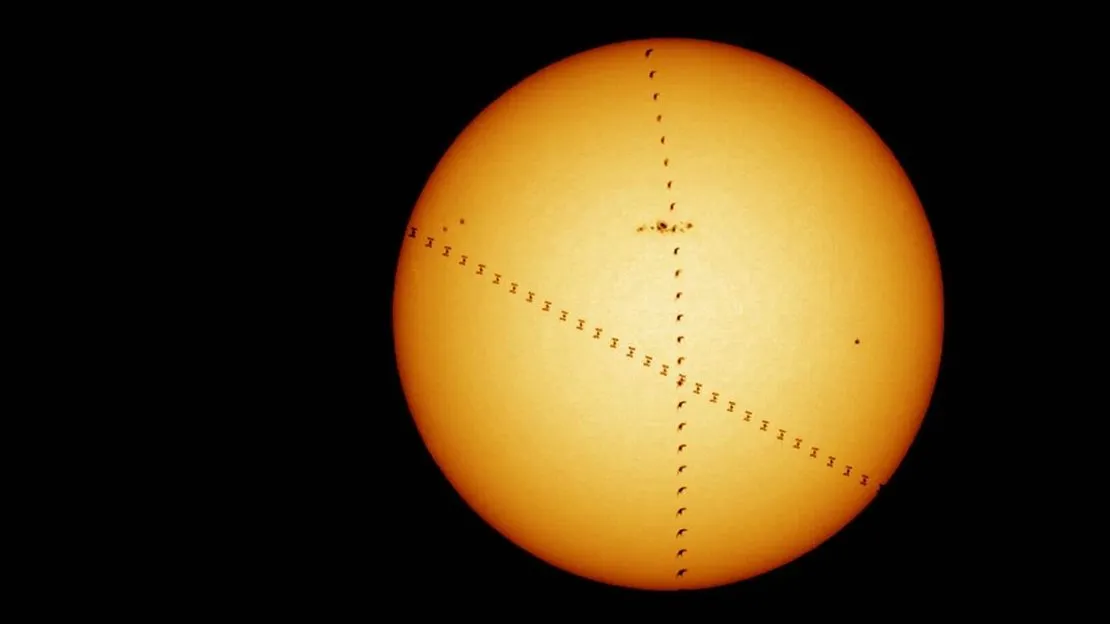
Talk about timing! Photographers with the European Space Agency hoping to spot the International Space Station crossing the face of the sun got more than they bargained for in this sunny snapshot.
In the photo, which was taken in 2013 but only released by ESA on Wednesday (Oct. 4), a bird crosses the sun at the same exact time as the space station. The entire photo session lasted just 1.2 seconds, making it a challenge for the astronomy club at ESA's European Space Astronomy Centre near Madrid, Spain. [In Photos: Spotting Satellites and Spaceships from Earth]
"It requires planning, patience and a measure of luck," ESA officials wrote in an image description. "The camera must be set up at the right time in the right place to capture the Space Station as it flies past at 28,800 km/h [17,900 mph]. At such speeds the photographer has only seconds to capture the transit, and if any clouds block the view, [they'd have] to wait for another opportunity weeks later."
While the skies were clear of clouds for this station-sun photo, at least one feathered flyer was in the viewing area.
"The station flies around Earth at [a distance of] around 400 kilometers [about 250 miles], allowing the astronomy club to calculate that the bird was flying 86 meters [280 feet] from the camera lens," ESA officials wrote. "The difference in size and distance makes both the bird and the space station appear the same size."
When the space station crosses the face of the sun, it is known as solar transit. Such transits can also occur other planets or stars, or with Earth's moon, as in this case of this stunning view of the station crossing the nearly full Harvest Moon captured this week by photographer Alexander Krivenyshev.
Editor's note: If you have an amazing photo of the full moon or any other night-sky sight that you'd like to share with us and our news partners for a possible story or image gallery, please contact managing editor Tariq Malik at [email protected].
Get the world’s most fascinating discoveries delivered straight to your inbox.
Email Tariq Malik at [email protected] or follow him @tariqjmalik and Google+. Follow us @Spacedotcom, Facebook and Google+. Original article on Space.com.

Tariq is the editor-in-chief of Live Science's sister site Space.com. He joined the team in 2001 as a staff writer, and later editor, focusing on human spaceflight, exploration and space science. Before joining Space.com, Tariq was a staff reporter for The Los Angeles Times, covering education and city beats in La Habra, Fullerton and Huntington Beach. He is also an Eagle Scout (yes, he has the Space Exploration merit badge) and went to Space Camp four times. He has journalism degrees from the University of Southern California and New York University.