













Seeds Are Nature's Most Efficient Ratchet
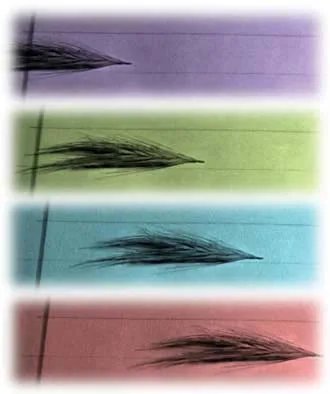
The seeds of many grasses are remarkable little mechanical devices. Each seed's hull has one or more bristle-like projections called awns, covered with tiny barbs pointing away from the seed.
When a seed is partly buried in the ground with its awn pointing up, the barbs form a simple ratchet. Each time the soil swells and shrinks with daily humidity changes, the ratchet drives the seed ever so slightly downward. (Awns also cling to animal fur for seed dispersal; they can cause problems when they ratchet their way into ear canals, nostrils, or other soft tissues.)
The basic blueprint of botanical ratchets has been known for more than a century, but figuring out exactly how the little gizmos work continues to inspire new research.
Biophysicist Igor M. Kulić of Harvard University and four colleagues recently studied the foxtail grass Hordeum murinum. The team measured the movement of foxtail awns and seed heads lying on various shaking experimental surfaces (including paper, fur, and fabric) and inside rubber tubes that were stretched to and fro. The awns always moved along "seedward," with longer awns making more efficient ratchets.
The team also modeled the foxtail ratchet mathematically. Kulić dubbed it "nature's most efficient ratchet," and thinks that high-tech gripping surfaces — of gloves or tires, perhaps — could profitably mimic its design.
The findings were detailed in the Proceedings of the Royal Society B.
Get the world’s most fascinating discoveries delivered straight to your inbox.