













Remains Found of 7,000-Year-Old Man Buried Upright
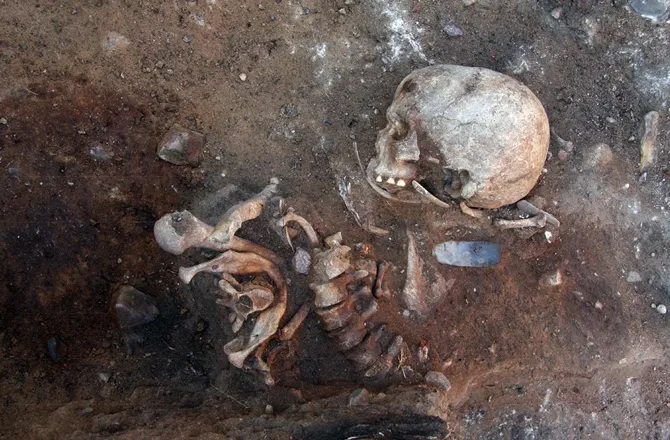
A Mesolithic site in Germany has revealed the 7,000-year-old remains of a young man buried there in a strange upright position.
Placed in a vertical pit, the body was fixed upright by filling the grave with sand up to the knees. The upper body was left to decay and was likely picked at by scavengers.
The unique burial was found near the village of Groß Fredenwalde, on top of a rocky hill in northeastern Germany, about 50 miles north of Berlin.
Skeleton of Burnt ‘Witch Girl’ Found in Italy
Dating back 8,500 years, the site belongs to the Mesolithic era when Europe was inhabited by hunter-gatherers who rarely stayed in one place.
Nine skeletons have been excavated so far, including five children younger than 6 years and the 8,400-year-old skeleton of a 6-month-old infant, with arms still folded across the chest.
According to Thomas Terberger, the excavation director at the Lower Saxony Department of Historic Preservation, the site was one of the first true cemeteries in Europe, used by native central European hunter-gatherers and fisherman from about 6400 B.C. to 500 B.C.
Get the world’s most fascinating discoveries delivered straight to your inbox.
“It is evidence for a more stable way of life some 8,000 years ago,” Terberger said.
Oldest Dentistry Found in 14,000-Year-Old Tooth
Detailing their findings in the journal Quaternary, Terberger and colleagues describe the skeleton buried upright as “without any parallel in central Europe.”
From the arrangement of the bones, the researchers speculate the young man was put — probably dead — into a 5 foot vertical pit.
Leaning with its back against the wall of the grave, the body was fixed in standing position by filling the pit with sands to a level above the knees.
“The pit was then left open or was preliminarily covered and subsequently carnivores were able to get at the corpse and gnaw on some of the arm bones,” the researchers wrote.
1,500-Year-Old Prosthesis Found With Skeleton
After decay, the upper body fell apart. The grave was then filled and sealed with a fire lit on top of the tomb.
“The burial is unique in central Europe and therefore it is difficult to find a specific reasons for such treatment,” Terberger told Discovery News.
“The young man also received grave goods and this is indicating an unusual, but honorable treatment of the body,” he added. “On this background, I see no good argument to interpret the burial as a kind of punishment.”
The outstanding preservation of the nine skeletons will allow researchers to carry out scientific analyses, such as ancient DNA tests and isotope studies.
“We will be able to better characterize the native population at that time, before and after the first farmers immigrated to Central Europe from Southeast-Europe about 7,500 years ago,” Terberger said.
Originally published on Discovery News.