













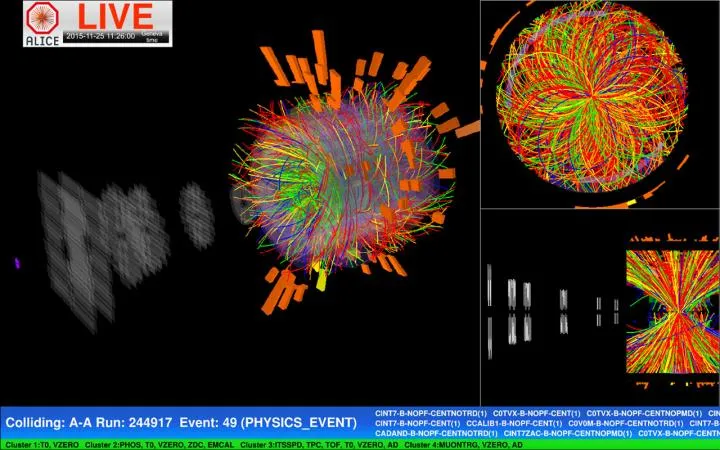
Slam!
The world's largest atom smasher has supersized its collisions, crashing heavy lead atoms into one another at the highest energy levels yet.
"The collision energy between two nuclei reaches 1,000 tera-electron volts. This energy is that of a bumblebee hitting us on the cheek on a summer day. But the energy is concentrated in a volume that is approximately 10 to 27 (a billion-billion-billion) times smaller," Jens Jørgen Gaardhøje, the head of the Danish research group within the A Large Ion Collider Experiment (ALICE) at CERN, said in a statement. "The energy concentration (density) is therefore tremendous and has never been realized before under terrestrial conditions." [In Photos: The World's Largest Atom Smasher]
The massive particle collisions could reveal insights into the flicker of time just after the Big Bang, when the entire universe was filled with a blazing hot primordial soup of the fundamental building blocks of matter called quarks, antiquarks and gluons.
Ramping up
The Large Hadron Collider, the 17-mile-long (27 kilometers) ring on the border between France and Switzerland, has been operating at higher energy levels since the summer. But those collisions used protons, which have an atomic mass of 1. The new experiments use much heftier lead nuclei, which have an atomic mass of about 208.
The new collisions convert all that energy into tiny flecks of matter made up of just quarks, antiquarks and gluons. The teensy speck of matter fleetingly reaches a temperature of 4,000 billion degrees.
Get the world’s most fascinating discoveries delivered straight to your inbox.
Normally, quarks are bound together into subatomic particles via gluons, which carry the strong nuclear force. But the intense collisions blow apart the particles and form a primordial soup that mimics the conditions in the billionth of a second after the Big Bang.
The team first turned on the lead beams for collisions on Nov. 25.
"The first collisions already tell us that more than 30,000 particles can be created in every central collision between two lead ions. This corresponds to an unprecedented energy density," of more than 40 times the energy density of a proton, Gaardhøje said.
Follow Tia Ghose on Twitter and Google+. Follow Live Science @livescience, Facebook & Google+. Original article on Live Science.

Tia is the editor-in-chief (premium) and was formerly managing editor and senior writer for Live Science. Her work has appeared in Scientific American, Wired.com, Science News and other outlets. She holds a master's degree in bioengineering from the University of Washington, a graduate certificate in science writing from UC Santa Cruz and a bachelor's degree in mechanical engineering from the University of Texas at Austin. Tia was part of a team at the Milwaukee Journal Sentinel that published the Empty Cradles series on preterm births, which won multiple awards, including the 2012 Casey Medal for Meritorious Journalism.