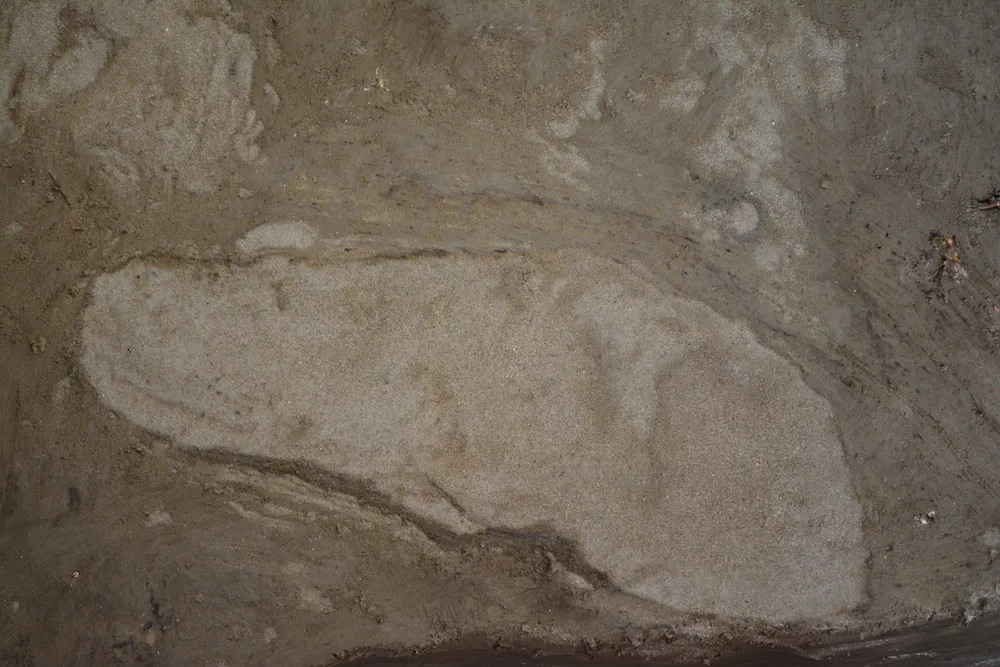
Stone Age fishermen left their mark on the Danish coast some 5,000 years ago, leaving behind evidence of carefully constructed traps and even their own footprints. Archaeologists on the island of Lolland, in the Baltic Sea, recently unearthed some of these prehistoric prints, marking the first time such a discovery has been made in Denmark the archaeologists said. Here are some images of this incredible find, courtesy of Lars Ewald Jensen, a project manager at the Museum Lolland-Falster. [Read Full Story About the Ancient Human Footprints]
Stone Age steps
This is a photo of one of the Stone Age footprints before its last cleaning, or “de-dusting,” according to Lars Ewald Jensen, a project manager with the Museum Lolland-Falster, which is leading the excavations of Lolland's terrain. The archaeologists will make an imprint, or flat mold, of the print to preserve it, Jensen told Live Science.
Lolland, Denmark's fourth largest island, has very flat terrain. The island was laced with inlets and streams until the end of the 19th century, when a deadly storm surge from the Baltic Sea prompted town leaders to build a dyke, according to Jensen. The fish fences that the archaeologists are excavating are located in the tents on the left side of this picture. The trees on the right obscure a view of the Baltic Sea.
Muddy feet
A close-up view of one of the footprints shows the fine layers of sand and mud that kept this print preserved for more than 5,000 years.
Sign up for the Live Science daily newsletter now
Get the world’s most fascinating discoveries delivered straight to your inbox.
Heave-ho!
Footprints were found on both sides of the remains of the fish fences, which are also known as fish weirs. The archaeologists think this may indicate that the fishermen were trying to pull the fences up from the ground when their feet sank into the ground, preserving their prints for millenia.
Seaside sacrifice
Archaeologists from the Museum Lolland-Falster are working to uncover all of the footprints. The team has also discovered the location of an ancient sacrifice, where wild and domestic animals were killed and offered to the sea, Jensen said.
Race against time
Jensen and his team have limited time to excavate the dried fjords of Lolland. In the near future, construction will begin on the Fehmarn Belt Fixed Link, an underwater tunnel that will connect Lolland with the German island of Fehmarn.