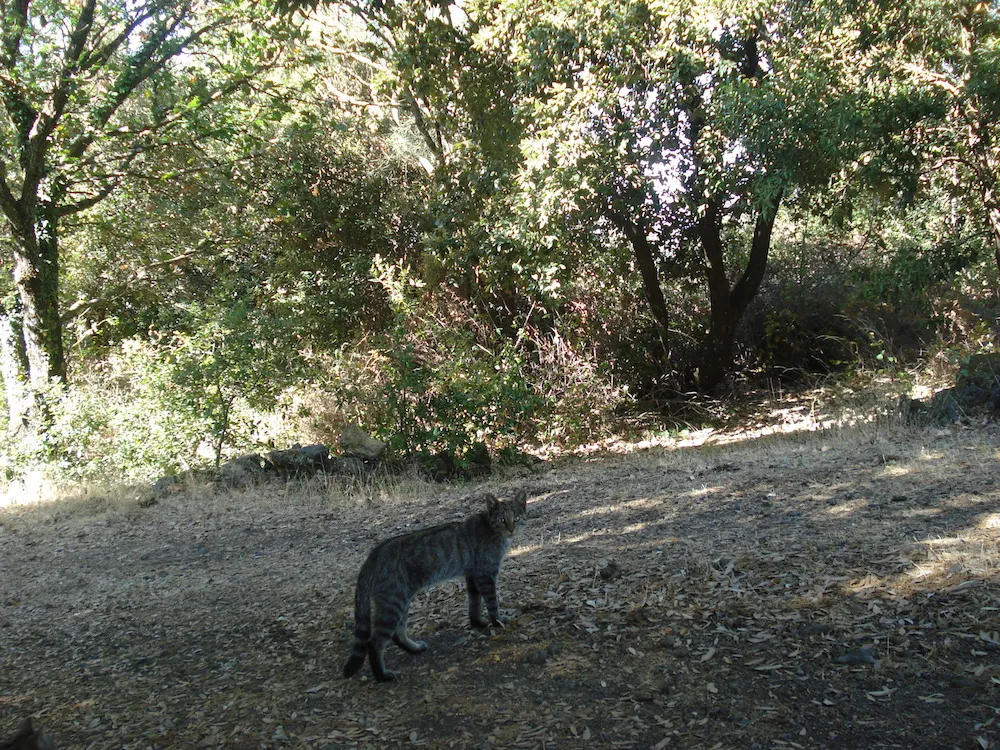
The European wildcat, a distant relative of domesticated cats, looks like a large tabby with long legs and a thick, black-tipped tail.
Say Cheese
(Image credit: Stefano Anile)
A researcher placed heat and motion sensing cameras in the forest around Mount Etna in Sicily to take 70 pictures of the wildcats over a period of four months.
Domestic Risk
(Image credit: Stefano Anile)
The European wildcat is at risk of interbreeding with domestic cats, researchers say. Scotland and Hungary both have high hybridization rates, whereas Spain, Portugal and Germany have fewer reported cases.
Female wildcats raise kittens that, like their parents, have distinct markings that distinguish them from domesticated tabby cats. European wildcats have a black stripe that runs along their back and stops at their tail, and have thicker and wavier stripes on the back of their necks than tabbies do.
Living The Good Life
(Image credit: Stefano Anile)
The European wildcats that live on the active Etna volcano in Sicily may eat the wild rabbits that live in the area, says the study's principal researcher Stefano Anile.
Mount Etna
(Image credit: Stefano Anile)
Wildcats live throughout Europe, but this is the first study to find that a healthy number of the felines live on Mount Etna.
Sign up for the Live Science daily newsletter now
Get the world’s most fascinating discoveries delivered straight to your inbox.
Laura is the managing editor at Live Science. She also runs the archaeology section and the Life's Little Mysteries series. Her work has appeared in The New York Times, Scholastic, Popular Science and Spectrum, a site on autism research. She has won multiple awards from the Society of Professional Journalists and the Washington Newspaper Publishers Association for her reporting at a weekly newspaper near Seattle. Laura holds a bachelor's degree in English literature and psychology from Washington University in St. Louis and a master's degree in science writing from NYU.