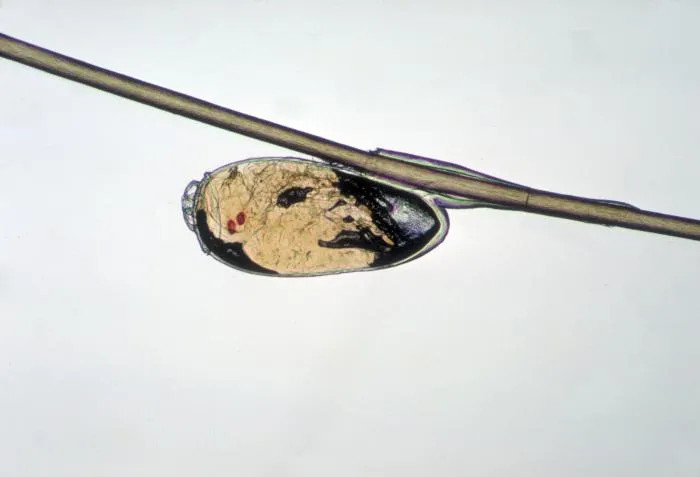
GAINESVILLE, Fla. — Clues to human evolution generally come from fossils left by ancestors and the molecular trail encoded in the human genome as it is tweaked over generations. However, some researchers are looking to another source: the bloodsucking louse.
Lice have been closely associated with humans for millennia; in spite of human attempts to get rid of the parasites, their persistence has made them a potential reservoir of information for those who want to know more about human evolution and history, said David Reed, associate curator of mammals at the Florida Museum of Natural History, on Sunday (Nov. 3) here at the ScienceWriters2013 conference.
"When we went through our evolutionary history, we didn’t do it by ourselves — we took a whole bunch of passengers with us," Reed said.
Latest Videos From
Clues from the bloodsucking hitchhikers, for instance, suggest modern humans intermingled with Neanderthals (a theory also supported by other genetic research) and that humans may have first put on clothing before leaving Africa.
Parasitic passengers with a story
Like family members on the same road trip, these passengers — otherwise known as parasites, including lice — can offer differing versions of the adventure, filling in gaps in other accounts, Reed said. He and colleagues have been looking to lice genomes to do just that. [The 10 Most Diabolical and Disgusting Parasites]
Lice, which infect many animals, are excellent trackers for their hosts' evolution. They spend their entire lives on their host, perish after a relatively short period of time if they fall off, and infest a single species of host, Reed told an audience at the conference sponsored by the National Association of Science Writers.
Humans are unusual among lice hosts; they provide homes for more than one species of lice. The pubic louse looks quite different from its counterparts in human hair and clothing. Through genetic analysis, Reed and colleagues determined that more than 3 million years ago, the human pubic louse originated from gorilla lice, where it adapted to grab onto large hairs spread farther apart. This finding means that humans and gorillas must have lived in close proximity during this time period. The information is significant, because gorilla fossils from this time are virtually nonexistent, Reed said.
Reed and colleagues have also looked at the split between head and clothing lice for clues as to when humans began wearing clothes. They found that clothing lice diverged from head lice between 80,000 and 170,000 years ago, most likely at the earlier end of that range.
This means humans were likely tinkering with clothing use before leaving Africa, Reed said.
A record of long-gone ancestors?
Lice genomes may also reveal information about interactions between modern humans' long-gone ancestors and relatives.
Researchers have identified three major lineages, dubbed Clades A, B and C, within the DNA from the mitochondria, or energy-producing centers of cells, of lice collected in sites around the world. Using variations in the DNA to look back in time, the researchers saw these groups had a common ancestor about 2 million years ago. Clade C then split off from the group. Much later, between 700,000 and 1 million years ago, Clade B split from A.
The timing of these splits, and the modern geographic distribution of these clades have led the researchers to suggest that C evolved on Homo erectus as this hominid emerged, and that B evolved on Neanderthals.
But these three louse lineages did not stay apart. Some interaction, such as hunting together, brought humans' ancient, lice-infested ancestors close enough together to reunite the three lineages all of which are now carried by modern humans, Reed and others suggest.
They are continuing work to understand better the histories encoded in lice DNA. With the caveat that the following work has not yet been vetted by the peer-review process, Reed said computer simulations of lice genetic evolution support this story. Meanwhile, full genome sequences from lice in Clades A and B indicate the two are interbreeding. (C is much rarer, and the researchers' samples turned out to be too degraded to sequence.)
Reed's lab is also applying lice genomics to study how people arrived in the Americas.
Follow us @livescience, Facebook & Google+. Original article on LiveScience.

 Live Science Plus