













There’s Gold In Them, Thar Hills -- And Toxic Mercury
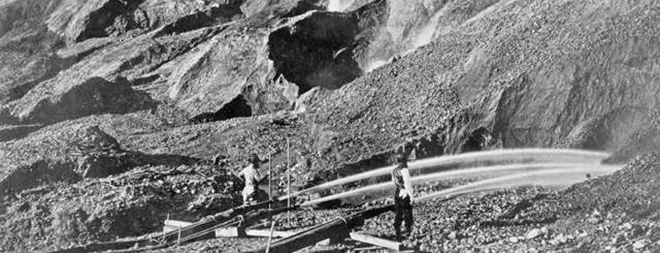
(ISNS) -- When gold was discovered in California in 1849, the miners were confronted with a problem: there were huge amounts of the precious metal in the foothills of the Sierra and the only way to get it out was to blast it out of the soil with high-pressure hoses.
The resulting mud containing the gold was run through sluices and mixed with mercury so the gold would settle to the bottom. The remains of the 19th-century practice are still visible in the area, and the poisonous mercury is now slowly making its way toward the fruit and nut orchards, and the rice fields of California’s lush Central Valley, America’s food basket, according to new research by a team of British and American scientists.
Every time there is a big flood -- usually once a decade -- the mercury in the sediment moves farther down into the valley. It could take 10,000 years for it all to finally be released from the sediment and spread out, the researchers said.
Their research is published in the Proceedings of the National Academy of Sciences. The scientists came from Scotland’s University of St. Andrews, the University of Exeter in England, Sonoma State University in California and the University of South Carolina.
Michael Singer of St. Andrews, who also holds an appointment at the University of California, Santa Barbara, said the plants in the area had not yet been tested for mercury, but the element also affects fish in the area and contamination of fish with mercury is “well-established.”
The area studied is called the Yuba Fan, built up around the Yuba River that runs out of the Sierra Nevada Mountains north of Sacramento, not far from California’s verdant wine country.
“The Yuba fan is totally artificial, created by humans,” said Singer. “When the miners realized the gold was tucked deep in sedimentary layers they invented hydraulic mining.” The fan contains more than a billion cubic meters of sediment reaching down to the Golden Gate.
Get the world’s most fascinating discoveries delivered straight to your inbox.
The miners used high pressure hoses, called monitors, to blast the hillsides, washing the gold-bearing mud into sluices. The process dramatically altered the landscape; massive mudslides filled whole valleys.
Mercury was added to the sluices to form an amalgam with the gold that settled to the bottom. The miners then burned off some of the mercury leaving the gold easier to collect. Much of it remained in the sediment. The sediment washed downstream, Singer said, actually forming new river valleys and terraces, the fan.
The practice was made illegal in 1884, but by that time some miners made a great deal of money, Singer said.
Meanwhile, the terraces acted like dams, holding back the contaminated soil. The researchers, using NASA imagery and historical data, found that every time there is a major flood, terraces fail and the contaminated soil moves further toward the lowlands.
Mercury taint from the Gold Rush has been found in the food supply in the San Francisco area, but the contamination in the Yuba fan is hundreds of times greater. Scientists believe trees do not absorb mercury so fruits and nuts may be safe, although that has not been tested. There is evidence, however, that rice may be vulnerable.
Mercury contamination from gold mining is a worldwide problem. Two years ago, scientists discovered that gold mining in the Amazon had already contaminated the food supply in the Madre de Dios area of Peru, in that case from burning off the mercury in the amalgam.
In another paper published this week, scientists at the Carnegie Institution for Science mapped the contamination at Madre de Dios using space satellites.
They found that the extent of gold mining there increased 400 percent from 1999 to 2012 and the loss of forest caused by the miners stripping the trees, had tripled since 2008, the time of the Great Recession when gold prices sky-rocketed. That paper also was published in the PNAS.
The destruction came from hundreds of gold mines, large and small, all unregulated.
“The first world and the third world are looking more and more alike,” said Barbara Fraser, a science journalist based in Peru and expert on the Amazon mining operations.
“There is certainly a parallel - what is happening in the Amazon - not just in Peru, but in Brazil, Guyana, Suriname and probably most or all of the other Amazonian countries -- is the modern version of the California and Klondike gold rushes. The tools are similar, mercury is used here, as it was there, and the mercury gets into the environment and stays there for a long time.”
This story was provided by Inside Science News Service. Joel Shurkin is a freelance writer based in Baltimore. He is the author of nine books on science and the history of science, and has taught science journalism at Stanford University, UC Santa Cruz and the University of Alaska Fairbanks. He tweets at @shurkin.