













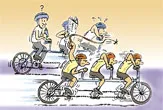
Nobody likes a freeloader. Social parasites live off the work of others, and a society infested with too many of them falls apart.
Given the chance, most people will punish moochers with "freeloader fines," even if it means taking a financial hit themselves, a new study finds.
Researchers at the University of Erfurt in Germany recruited 84 students to play a game in which they were given the choice of joining a group that punished freeloaders or one that didn’t.
The students were given 20 units of fake money, which they could trade in for real cash after the experiment. Players could hoard their money or contribute to a group pot. At the end of the game, the pot was increased by about two thirds and then divided equally among all the players, regardless of their contributions.
After contributions were made, the amount that each player donated was made known to other team members. In the group that allowed punishment, players could fine freeloaders three units, but it meant being docked one unit themselves.
The game was repeated thirty times. After each round, players had the option of remaining in their current group or switching to the other one.
Going into the first round, nearly two thirds of the students chose the punishment-free group. After the 30th round, however, the group that punished freeloaders was by far more popular; only a few stragglers were left in the punishment-free group.
Get the world’s most fascinating discoveries delivered straight to your inbox.
The finding supports the idea that institutions able to police themselves foster cooperation between their members and out-compete institutions that let freeloaders go unpunished, the scientists say.
The study, led by Ozgur Gurerk, is detailed in the April 7th issue of the journal Science.