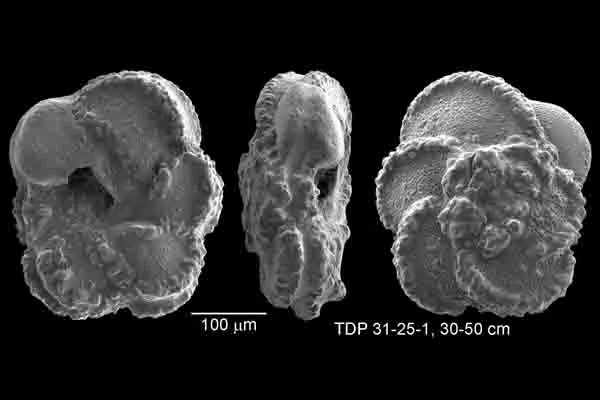
The fine clay sediments that settled on the seafloor in this region during the Cretaceous ensured the excellent preservation of many types of microfossil shells. These high magnification images show three views of a single planktic foraminifer. The shell is so well-preserved that the specimen looks like it died yesterday, not more than 92 million years ago.
Clay-rich marine sediments in southeastern Tanzania contain some of the world's best-preserved fossils of ocean-dwelling microorganisms, including the foraminifera that I use to study ancient climate and ocean systems.
Foraminifera are tiny, single-celled sea creatures with solid shells, and they have lived in the oceans since the Cambrian Period more than 500 million years ago.
To reach the fossils, buried between 66 million and 112 million years ago, my colleagues and I used a drill rig to cut deep into the earth. Despite being buried for so long, the original chemistry of the fossil shells has not been altered. This makes it possible to measure the concentrations of various oxygen isotopes in the shells — data that allow scientists to reconstruct ocean temperatures at the times when the foraminifera lived.
A typical drilling site. The rig is set up next to a baobab tree. It was the dry season, so the tree had no leaves. Rain and core cutting don't mix.
(Image credit: Brian Huber.)
Foraminifera incorporate 16O(oxygen atoms with eight neutrons in their nuclei, the most common isotope) and 18O(less common, but ever-present, heavier isotopes of oxygen with 10 neutrons in their nuclei) into their calcium carbonate shells in a ratio that is proportional to water temperature.
Scientists measure isotope ratios in the fossils by dissolving the shells in acid and analyzing the resulting carbon dioxide gas in a mass spectrometer. We then calculate ancient ocean-water temperatures by inserting the oxygen isotope ratios into an empirically determined temperature equation.
Paleoclimatologists are particularly interested in a period between 94 million and 90 million years ago, when global temperatures were the highest they have been in the last 250 million years. We determined that ocean surface temperatures off the coast of Tanzania ranged from 90 to 95 degrees Fahrenheit (32 to 35 degrees Celsius), which is about 9 to 14 F (5 to 8 C) degrees higher than subtropical surface water temperatures of today.
Sign up for the Live Science daily newsletter now
Get the world’s most fascinating discoveries delivered straight to your inbox.
Night lighting on the drill rig allowed for 24-hour drilling, but the scientists could only work in the research tent during daylight since the computers ran off solar power and the team needed lots of light for photography. After photographing, describing and sampling cores all day, the scientists returned to the lodgings, where electricity allowed them to study microfossils from each day's cores on microscopes set up in the rooms.
(Image credit: Ines Wendler)
This "supergreenhouse" world supported the growth of lush forests, large dinosaurs and other temperature-sensitive organisms at both poles. It probably resulted from much higher concentrations of carbon dioxide and other greenhouse gases that were expelled into the atmosphere during a long period of undersea volcanic activity.