















Pre-Human Giggles: Laughter Goes Back 10 Million Years

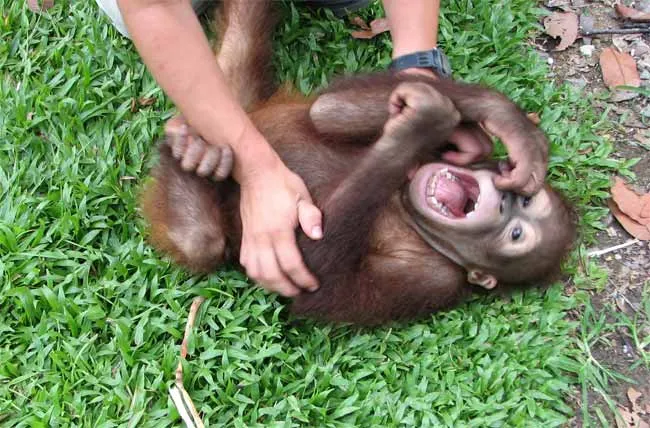
At least 10 million years ago, our ancestors may have been laughing it up over the latest stone-age prank or bout of tickling.
The idea of prehistoric laughter comes from a new study in which researchers tickled the palms, feet, necks and armpits of 22 juvenile and infant apes and three human babies. The resulting giggles were recorded and analyzed for various acoustic features.
The great apes are our closest living relatives (in fact, we technically are also great apes), so behavioral and other similarities between such apes and humans would suggest a common origin. In this study, the great apes included orangutans (Pongo pygmaeus), gorillas (Gorilla gorilla), chimpanzees (Pan troglodytes) and bonobos (Pan paniscus).
Story continues below...
{{ video="LS_090604_ape-laughter" title="Laughing Apes" caption="When tickled, a juvenile orangutan and an adolescent gorilla make laughter sounds. Credit: University of Portsmouth" }}
Despite many differences in great ape and human laughter, the analyses showed an unexpected similarity. Gorillas and bonobos laughed while breathing out for three to four times longer than their normal breathing cycle, showing these apes have some control of their breathing. Study team member Marina Davila Ross, a primatologist of the psychology department at the University of Portsmouth in England, said such ability was thought to be unique to humans, and to have played an important role in the evolution of speech.
In general, the similarities and differences in patterns of laughter sounds in the great apes and humans corresponded closely with the evolutionary relationships between the species based on genetic closeness.
Get the world’s most fascinating discoveries delivered straight to your inbox.
The match-up provides strong evidence, the researchers say, that laughter in great apes and humans has its origins with our evolutionary ancestors and can be traced back 10 million to 16 million years to the last common ancestor of humans and great apes.
"Our results on laughter indicate its pre-human basis," Davila Ross said. "It is likely that great apes use laughter sounds to interact in similar ways to humans."
The research, published in the June 4 issue of the journal Current Biology, was funded by the University of Veterinary Medicine and the Centre for Systems Neuroscience in Hannover.
- Video – Laughing Apes
- Top 10 Missing Links
- Video - Jane Goodall's Wild Chimpanzees
