














Mount Etna Volcano Snapped from Space

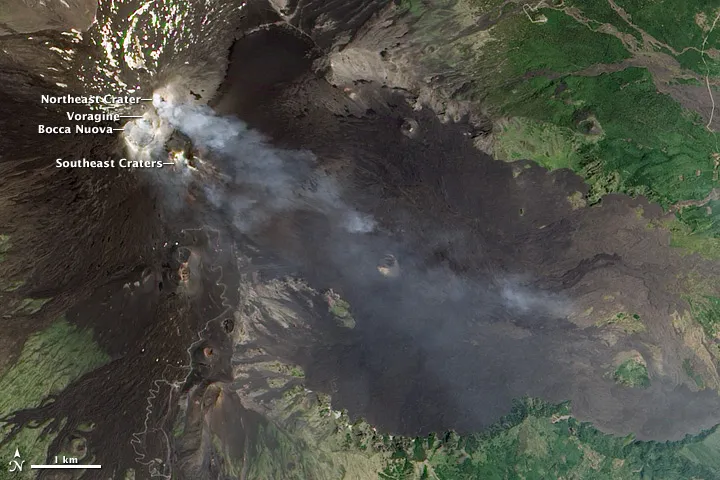
Italy's Mount Etna, one of the most active volcanoes on Earth, is spewing out plumes of bluish volcanic gas, as revealed in a recent satellite image.
The restive peak, located on the island of Sicily, has been erupting in spectacular fashion on and off since it ramped up activity in January 2011.
The mountain last spewed out fountains of glowing lava on April 24, and has been relatively quiet ever since.
Even when Mount Etna is not belching out molten rock, it releases steady puffs of volcanic gas. The image above was snapped by NASA's Earth Observing-1 satellite on June 26, and the volcano's blue-tinted plume can be seen.
Between January and August 2000, the mountain experienced 66 of these episodes of "lava fountaining," and a total of 250 since 1995. These dramatic displays sometimes send tiny pieces of light volcanic rocks and clouds of ash raining down on nearby towns, but none of the recent eruptions have proved dangerous.
The volcano put on a particularly breathtaking show on April 1, when a local scientist snapped a series of stunning images of the erupting peak.
The 10,925-foot (3,330-meter) volcano has one of the longest documented histories of activity on Earth. Humans have been noting its eruptions since 1500 B.C.,
Get the world’s most fascinating discoveries delivered straight to your inbox.
Follow OurAmazingPlanet for the latest in Earth science and exploration news on Twitter @OAPlanet. We're also on Facebook & Google+.
