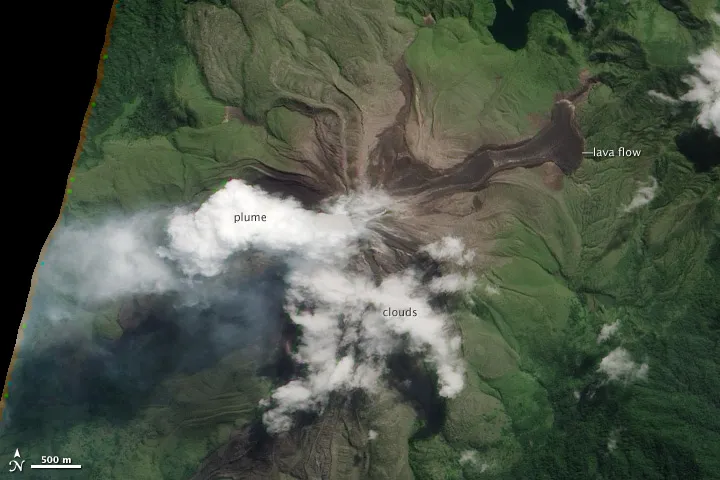
Bagana volcano is one of the most active in Papua New Guinea, but it is remote, and so poorly monitored.
Located on the mountainous spine of Bougainville Island, it is both far from any cities or large towns and is hard to reach due to the rough terrain around it. Satellites are the best way for volcanologists to keep an eye on the active peak, which has an elevation of 5,741 feet (1,750 meters).
The volcano emits gases (including water vapor and sulfur dioxide) almost continuously, and frequently spits up thick lava flows.
Bagana volcano seen in the context of its surroundings.
(Image credit: NASA)
A natural-color image taken by NASA's Earth Observing-1 satellite on May 16 reveals a fresh lava flow on Bagana's eastern flank. Other satellite imagery suggests that the flow was erupted sometime between March 2011 and February 2012.
The fresh lava is dark brown, while lighter brown areas were likely stripped of vegetation by volcanic debris or acidic gases. Older lava flows are covered in light green vegetation, and the surrounding forests are dark green. The volcanic plume and clouds are both white.
Sign up for the Live Science daily newsletter now
Get the world’s most fascinating discoveries delivered straight to your inbox.