














Astronaut Snaps Spectacular Meteor Photo From Space

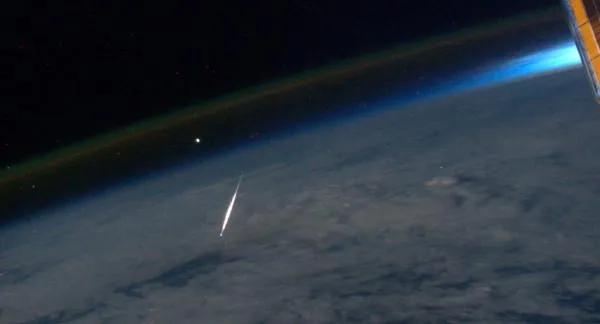
The annual Perseid meteor shower peaked this weekend, and one astronaut living aboard the International Space Station captured a stunning view of the light show from space.
NASA astronaut Ron Garan photographed a "shooting star" streaking through Earth's atmosphere on Saturday (Aug. 13), as the space station orbited roughly 220 miles (354 kilometers) above the planet.
"What a 'Shooting Star' looks like #FromSpace," Garan wrote in a message on Twitter, where he posts photos and updates on his space mission.
The Perseid meteor shower peaked Friday (Aug. 12), and despite competing with a bright full moon, many skywatchers around the world were treated to dramatic views.
{brightcove 932}
Every August, Earth passes through a stream of dust particles and debris from the comet Swift-Tuttle. As the specks of dust hit the top of Earth's atmosphere at blistering speeds of up to 140,000 miles per hour (250,000 kph), they burn up and form bright meteors that can be seen across the sky. [Skywatcher Photos: The 2011 Perseid Meteor Shower]
The meteors stream out of the constellation of Perseus, which is how the light show got the name "Perseids." International skywatchers observed up to 20 meteors per hour during the height of this year's Perseid meteor shower, according to the website Spaceweather.com.
Get the world’s most fascinating discoveries delivered straight to your inbox.
This year, the meteor shower's peak coincided with the full moon of August, which likely outshone some of the fainter Perseids that would normally be visible darting across a darker sky.
While Garan's cameras were trained on Earth during the meteor shower, his current home in space the International Space Station made a series of early morning flybys over the U.S.
But, don't fret if you missed last week's meteor shower, there are plenty of other skywatching events in August to catch. You just have to know when to look up.
This story was provided by SPACE.com, a sister site to OurAmazingPlanet. You can follow SPACE.com staff writer Denise Chow on Twitter @denisechow. Follow SPACE.com for the latest in space science and exploration news on Twitter @Spacedotcom and on Facebook.

Denise Chow was the assistant managing editor at Live Science before moving to NBC News as a science reporter, where she focuses on general science and climate change. Before joining the Live Science team in 2013, she spent two years as a staff writer for Space.com, writing about rocket launches and covering NASA's final three space shuttle missions. A Canadian transplant, Denise has a bachelor's degree from the University of Toronto, and a master's degree in journalism from New York University.