














Pyramid Lake, the Last Remnant of an Ancient Lake

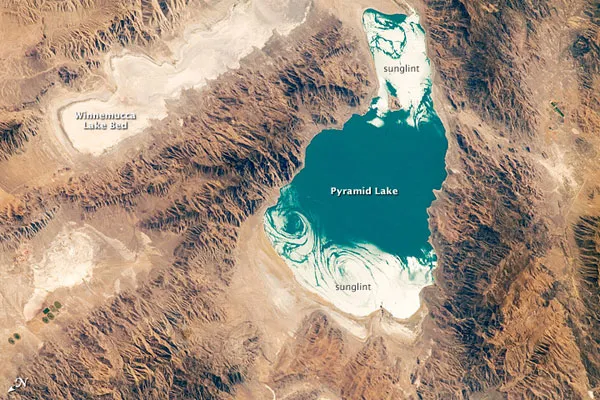
This image, taken by an astronaut shows Pyramid Lake in western Nevada, roughly 40 miles (64 kilometers) from Reno.
Pyramid Lake is a remnant of the ancient and much larger Lake Lahontan, which formed during the last ice age when the regional climate was significantly cooler and wetter.
Pyramid Lake and the now-dry Lake Winnemucca, to its left, are two of seven smaller lakes that together formed a large single Lake Lahontan when water levels were higher. At its peak volume during the late Pleistocene Epoch (approximately 15,000 years ago), Lake Lahontan covered much of western Nevada and extended into California.
The deepest part of Lake Lahontan survives today as Pyramid Lake with a depth of 890 feet (270 meters). The lake also acts as the geographic sink for the Truckee River.
Pyramid Lake takes its name from one such pyramid-shaped deposit of tufa, rock formed by the precipitation of calcium carbonate from spring water, lake water, or a combination of the two. Over time, these deposits develop a wide variety of forms such as mounds, towers, sheets and reefs.
The tufa is exposed when water levels drop due to changes in regional climate, the diversion of water for human use, or both (Mono Lake in California for example).
The photograph also captures sunglint light reflected off of a water surface back towards the observer on opposite ends of the lake. Two large spiral whorls are visible in sunglint at the northern end, likely the result of wind patterns that disturb the water surface and cause localized variations in the amount of light reflected back to space.
Get the world’s most fascinating discoveries delivered straight to your inbox.
- Great Lakes Seen Clearly from Space
- Observing Earth: Amazing Views from Above
- What's the Deepest Lake in the World?
