
 Live Science Plus


Comet, Not Asteroid, Killed Dinosaurs, Study Suggests

Updated March 22 at 5:36 p.m. ET
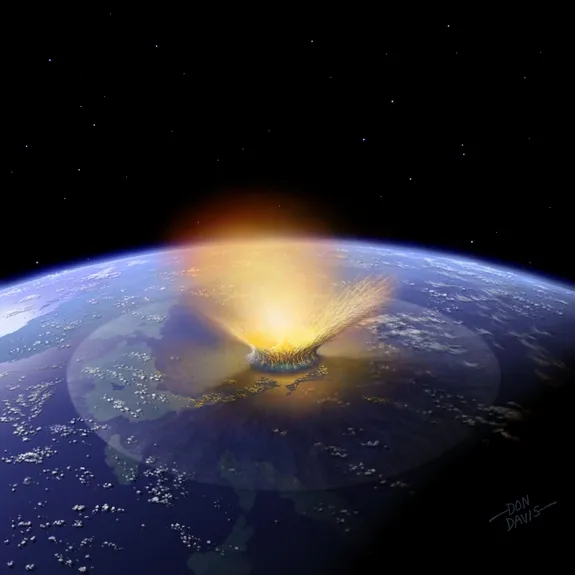
The rocky object that wiped out the dinosaurs 65 million years ago may have been a comet, rather than an asteroid, scientists say.

Evidence of the space rock's impact comes from a worldwide layer of sediments containing high levels of the element iridium, dubbed the Cretaceous-Paleogene (K-Pg) boundary, which could not have occurred on Earth naturally.
The new research suggests the often-cited iridium values are incorrect, however. The scientists compared these values with levels of osmium, another element delivered by the impact.
Their calculations suggested the space rock generated less debris than previously thought, implying the space rock was a smaller object. In order for the smaller rock to have created the giant Chicxulub crater, it had to have been going exceedingly fast, the researchers concluded.
"How do we get something that has enough energy to generate that size of crater, but has much less rocky material? That brings us to comets," study author Jason Moore, a paleoecologist at Dartmouth College in New Hampshire, told BBC News. [Meteor Crater: Experience an Ancient Impact]
Comets are balls of ice, dust and rocky particles that are distinguished from asteroids by their highly eccentric orbits and thin, fuzzy atmospheres, called comas or tails. The Chicxulub impact is more compatible with a long-period comet, the results indicated, which can take hundreds, thousands or sometimes millions of years to orbit the sun once.
It is possible that a rapidly moving asteroid could have caused the Chicxulub impact crater, the researchers said, but the fastest-moving objects that have been observed are mostly comets.
"I think it's some very interesting work," physicist Brandon Johnson of Purdue University, who was not involved in the research, told LiveScience. If the impact were in fact a comet, "it could change things quite a bit," he said – a comet would have rained down a lot more material than an asteroid.
But the findings are debatable: "There's a possibility that a lot of the impacted material could have been ejected at escape velocity, so we couldn't find it on Earth," Johnson said. This means the remnants of the impact could be just a fraction of the mass of the space rock, suggesting it could still have been an asteroid.
Geologist Gareth Collins of Imperial College London, U.K., agreed. "Geochemistry tells you — quite accurately — only the mass of meteoritic material that is distributed globally, not the total mass of the impactor," Collins told BBC News, adding, "To estimate the latter, one needs to know what fraction of the impactor was distributed globally, as opposed to being ejected to space or landing close to the crater."
The researchers suggest that 75 percent of the space rock's mass was distributed on Earth, Collins said, but he contends that it could have been less than 20 percent — an amount that could have come from a larger and slower asteroid. In response, the researchers point to studies that suggest the object lost an amount of mass consistent with their findings.
But geophysicist Jay Melosh, also of Purdue University, remains skeptical. "The evidence that they have for a high velocity impact is marginally positive. However, the probability that that high velocity impact is a comet is very low," he said, adding that it's much more likely to be a faster-than-usual asteroid.
Follow Tanya Lewis on Twitter and Google+. Follow us @livescience, Facebook & Google+. Original article on LiveScience.com.
Editor's Note: This article was updated to include comments from geophysicist Jay Melosh of Purdue University.
