















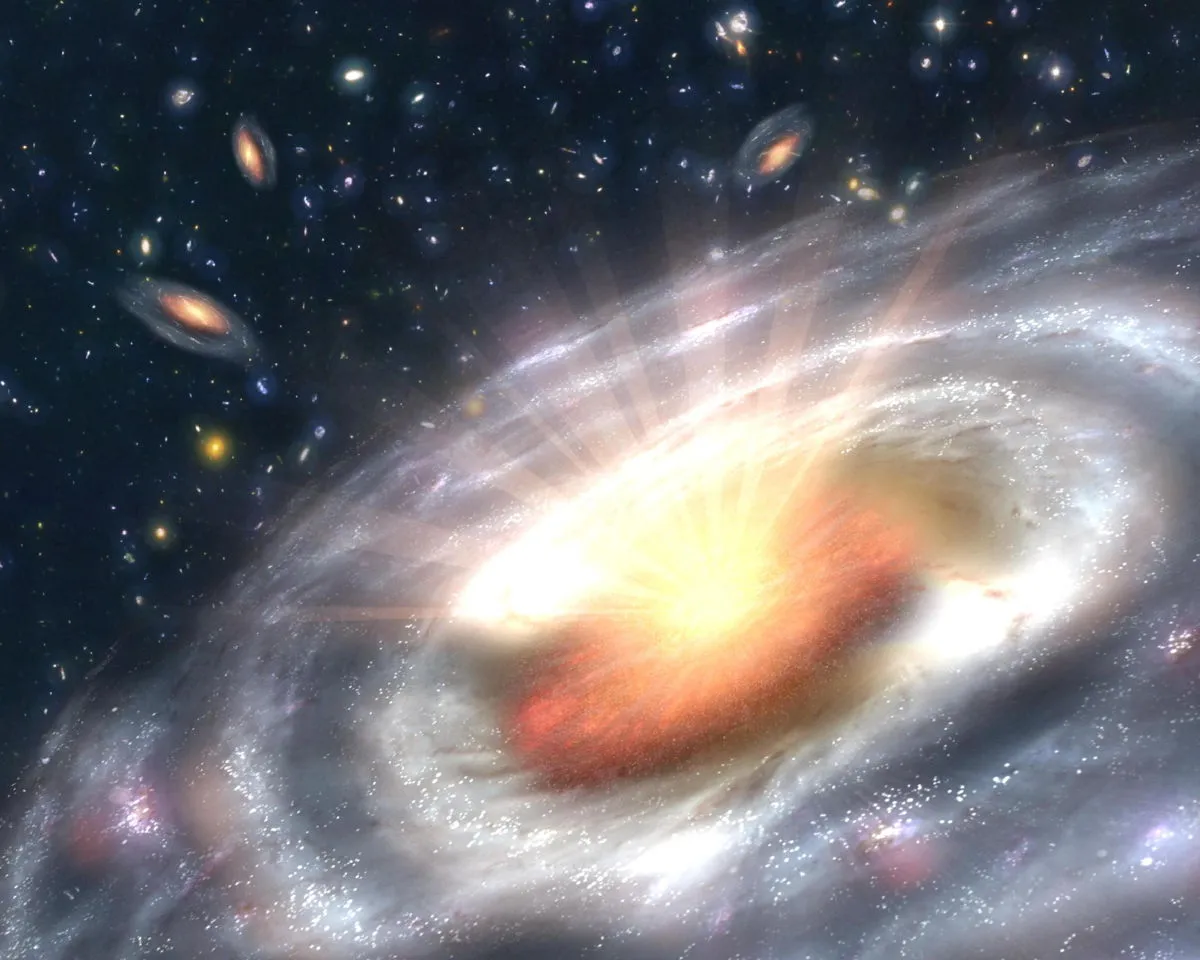
NASA will reveal new findings about black holes during a news conference Wednesday (Feb. 27).
The news conference, which starts at 1 p.m. EST (1800 GMT) Wednesday, will relay results based primarily on observations made by two X-ray space telescopes: NASA's Nuclear Spectroscopic Telescope Array (NuSTAR) and the European Space Agency’s XMM-Newton observatory, NASA officials said.
The scientists participating in the briefing are:
- Fiona Harrison, NuSTAR principal investigator at Caltech in Pasadena
- Guido Risaliti, astronomer at the Harvard-Smithsonian Center for Astrophysics in Cambridge, Mass.
- Arvind Parmar, head of Astrophysics and Fundamental Physics Missions Division, European Space Agency
NASA will stream audio of the teleconference, along with participants' visual aids, live at http://www.ustream.tv/nasajpl2. SPACE.com will carry the NASA feed here.
The $165 million NuSTAR observatory launched in June 2012, kicking off a planned two-year mission to study the universe in high-energy X-ray light. The telescope's observations should help scientists better understand galaxy formation, black hole growth and other phenomena, mission team members have said.
XMM-Newton is a grizzled space veteran by comparison. The telescope launched in December 1999 and has been probing X-ray emissions around the universe ever since.
This story was provided by SPACE.com, a sister site to Live Science. Follow SPACE.com senior writer Mike Wall on Twitter @michaeldwall or SPACE.com @Spacedotcom. We're also on Facebook and Google+.
Get the world’s most fascinating discoveries delivered straight to your inbox.
