













Higgs Boson Particle May Spell Doom For the Universe

This story was updated on Feb. 20 at 9:35 a.m. ET.
BOSTON — A subatomic particle discovered last year that may be the long-sought Higgs boson might doom our universe to an unfortunate end, researchers say.
The mass of the particle, which was uncovered at the world's largest particle accelerator — the Large Hadron Collider (LHC) in Geneva — is a key ingredient in a calculation that portends the future of space and time.
"This calculation tells you that many tens of billions of years from now there'll be a catastrophe," Joseph Lykken, a theoretical physicist at the Fermi National Accelerator Laboratory in Batavia, Ill., said Monday (Feb. 18) here at the annual meeting of the American Association for the Advancement of Science.
"It may be the universe we live in is inherently unstable, and at some point billions of years from now it's all going to get wiped out," added Lykken, a collaborator on one of the LHC's experiments. [Gallery: Search for the Higgs Boson]
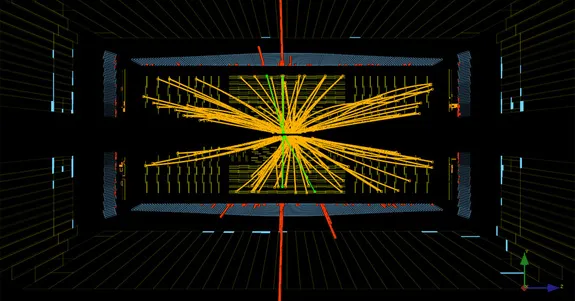
The Higgs boson particle is a manifestation of an energy field pervading the universe called the Higgs field, which is thought to explain why particles have mass. After searching for decades for proof that this field and particle existed, physicists at the LHC announced in July 2012 that they'd discovered a new particle whose properties strongly suggest it is the Higgs boson.
To confirm the particle's identity for sure, more data are needed. But many scientists say they're betting it's the Higgs.
Get the world’s most fascinating discoveries delivered straight to your inbox.
"This discovery to me was personally astounding," said I. Joseph Kroll, a University of Pennsylvania physicist who also works at the LHC. "To me, the Higgs was sort of, it might be there, it might not. The fact that it's there is really a tremendous accomplishment."
And finding the Higgs, if it's truly been found, not only confirms the theory about how particles get mass, but it allows scientists to make new calculations that weren't possible before the particle's properties were known.
For example, the mass of the new particle is about 126 billion electron volts, or about 126 times the mass of the proton. If that particle really is the Higgs, its mass turns out to be just about what's needed to make the universe fundamentally unstable, in a way that would cause it to end catastrophically in the far future.
That's because the Higgs field is thought to be everywhere, so it affects the vacuum of empty space-time in the universe.
"The mass of the Higgs is related to how stable the vacuum is," explained Christopher Hill, a physicist at Ohio State University. "It's right along the critical line. That could either be a cosmic coincidence, or it could be that there's some physics that's causing that. That's something new, which we didn't know before."
Strikingly, if the Higgs mass were just a few percent different, the universe wouldn't be doomed, the scientists said.
But even if the universe is in for an unfortunate end, there is at least one reason for consolation.
"You won't actually see it, because it will come at you at the speed of light," Lykken said. "So in that sense don't worry."
Editor's Note: This story was updated to correct Christopher Hill's affiliation, which is Ohio State University, not the Fermi National Accelerator Laboratory, as was originally stated.
Follow Clara Moskowitz on Twitter @ClaraMoskowitz or LiveScience @livescience. We're also on Facebook & Google+.
