














New Australian National Park Features Unique 'Horizontal Falls'

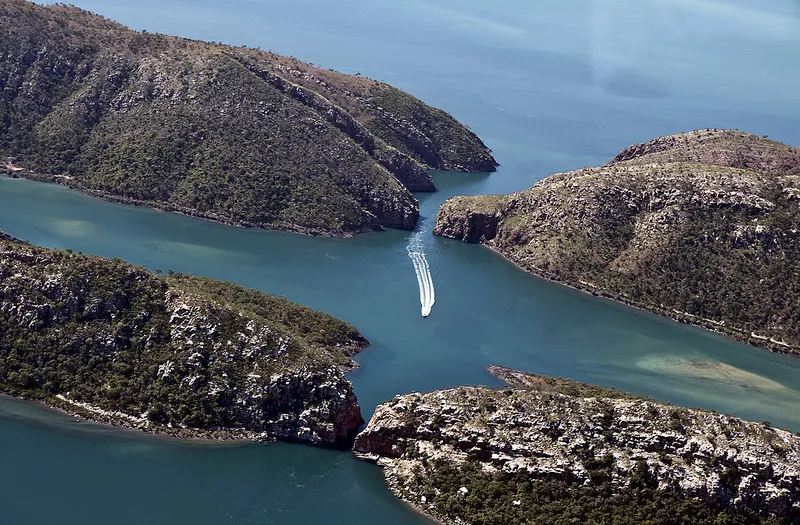
A unique feature along the coast of Western Australia, where water surges through a "horizontal waterfall," is part of a new Australian national park and marine park declared by the national government along the scenic shoreline.
The new park is situated in the Kimberley region, the northernmost part of the state of Western Australia. The region is bordered on the west by the Indian Ocean, on the north by the Timor Sea, on the east by the Northern Territory and on the south by the Great Sandy and Tanami Deserts.
Despite its name, the Horizontal Falls are a coastal feature that isn't a waterfall at all — it is a set of parallel gorges with narrow openings through which seawater rushes with the ebb and flow of the tide, in a waterfall-like effect. They are located within Talbot Bay on the Buccaneer Peninsula.
"The extraordinary Horizontal Falls are an internationally renowned tourist attraction and it is imperative we maintain the pristine environment that surrounds them," said Western Australia Premier Colin Barnett in a statement.
Both the national park and marine park will be designated Class A by the government, which gives them the highest level of protection, according to the Western Australia government statement.
While the final borders of the parks have yet to be determined, the marine park would cover about 1,160 square miles (3,000 square kilometers) and would protect coral reefs, dolphins and mangrove forests, the statement said. The new marine park will expand the Great Kimberley Marine Park to 10,000 square miles (26,000 square km).
"Protecting the Kimberley coast and its marine and bird life provides a balance to the rapid spread of mining and other industrial development," John Carey, the Pew Environment Group's Kimberley Conservation Project director, told the Australian Associated Press.
Get the world’s most fascinating discoveries delivered straight to your inbox.
The marine park would be multiple-use, with fishing and tourism opportunities. Existing pearling leases will also be maintained, the government statement said.
The park with be managed jointly with its traditional owners, the Dambimangari people, the premier said.
This story was provided by OurAmazingPlanet, a sister site to LiveScience. Reach Andrea Thompson at [email protected] and follow her on twitter @AndreaTOAP. Follow OurAmazingPlanet on Twitter @OAPlanet. We're also on Facebook and Google+.

Andrea Thompson is an associate editor at Scientific American, where she covers sustainability, energy and the environment. Prior to that, she was a senior writer covering climate science at Climate Central and a reporter and editor at Live Science, where she primarily covered Earth science and the environment. She holds a graduate degree in science health and environmental reporting from New York University, as well as a bachelor of science and and masters of science in atmospheric chemistry from the Georgia Institute of Technology.