














Wanted: Asteroid-Smashing Ideas for European Spacecraft

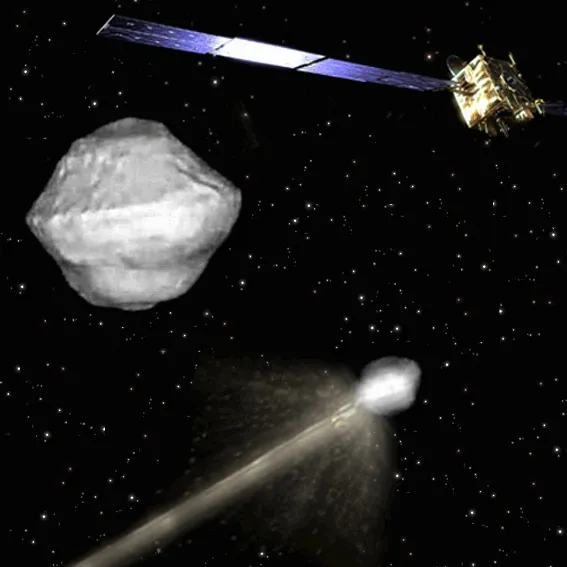
European space officials are seeking ideas to help develop a mission to knock an asteroid off its course, in case one day humans must pull off such a stunt to save Earth from a catastrophic space-rock collision.
The idea behind the joint US-European mission, dubbed AIDA (for Asteroid Impact & Deflection Assessment), is to send two small spacecraft to intercept a binary asteroid Didymos, which is projected to travel past Earth in 2022. This space rock system is actually a pair of asteroids, one smaller, one larger, that orbit each other as they zoom around the sun.
One 600-pound (300-kg) spacecraft, the Double Asteroid Redirection Test (DART) craft developed by researchers at Johns Hopkins University, would smash into the smaller of the two asteroids. The impact would knock the 500-foot- (150-meter-) wide space rock off its regular orbit.
Meanwhile, the European Space Agency's Asteroid Impact Monitor (AIM) craft would survey the collision. The crash would take place about 6.5 million miles (10.5 million kilometers), meaning scientists on the ground would also be able to measure the deflection using telescopes.
"The advantage is that the spacecraft are simple and independent," Andy Cheng of Johns Hopkins, who heads the U.S. side of the AIDA asteroid deflection project, said in a statement. "They can both complete their primary investigation without the other one."
ESA officials said that they are now seeking concepts for both ground- and space-based investigations to study of the physics of high-speed collisions between objects like a spacecraft and an asteroid.
This story was provided by SPACE.com, a sister site to Live Science. Follow SPACE.com on Twitter @Spacedotcom. We're also on Facebook and Google+.
Get the world’s most fascinating discoveries delivered straight to your inbox.
