













Raccoon Tumor Outbreak May Give Cancer Clues

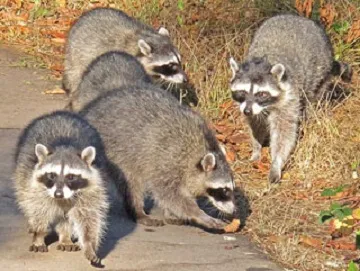
Raccoons rarely get tumors, so when 10 of the creatures with the same type of deadly growth turned up around Marin County, California, pathologists took note.
The raccoons all had been submitted for a routine necropsy after they were seen acting strangely before they died, wandering in the daylight and approaching humans. Researchers discovered that rabies, often the culprit for such symptoms, didn't seem to be the problem. Rather, these raccoons all had brain tumors that extended from the olfactory tract to the frontal lobe. Pathologists suspect the growths were caused by a newly described infectious agent, dubbed raccoon polyomavirus.
While polyomaviruses are known to cause cancer under laboratory conditions, researchers know little about how they cause cancer under natural conditions in people, because like other virus-associated cancers, the disease typically takes decades to develop.
The raccoon polyomavirus outbreak — which is not expected to pose a risk to people or other animals — could provide a good model for studying how such viruses might spread and cause cancer in humans, especially since raccoons usually only live up to three years.
"Understanding how infectious agents may contribute to cancer in animals has provided fundamental new knowledge on the cause of cancer in people," Michael Lairmore, dean of the UC Davis School of Veterinary Medicine, said in a statement.
Although cancer isn't typically considered something you can catch, a recent study found that one in six cases worldwide is caused by an infection. According to that article in the journal The Lancet, about 2 million, or 16 percent, of the 12.7 million cancer cases in 2008 were caused by an infectious agent, such as human papillomaviruses (HPV), hepatitis B virus, and Epstein-Barr virus.
The 10 raccoons in the study — nine from northern California, one from southern Oregon — were among 52 submitted for a examination at the California Animal Health and Food Safety Laboratory at UC Davis from March 2010 to May 2012. Two more raccoons with the tumor and the virus were found in Yolo and Marin Counties after the study was submitted for publication in September in the journal Emerging Infectious Diseases.
Get the world’s most fascinating discoveries delivered straight to your inbox.
"This is just the beginning of a story," said Patricia Pesavento, a UC Davis pathologist, who is collecting new specimens from across the country, looking for the virus in raccoons. Pesavento said in a statement that more research is needed to understand whether an environmental toxin, genetics or another factor is contributing to the cancer.
"Wildlife live in our fields, our trash cans, our sewer lines, and that's where we dump things," Pesavento said. "Humans need to be guardians of the wildlife-human interface, and raccoons are important sentinel animals. They really are exquisitely exposed to our waste. We may be contributing to their susceptibility in ways we haven't discovered."
Follow LiveScience on Twitter @livescience. We're also on Facebook & Google+.
