















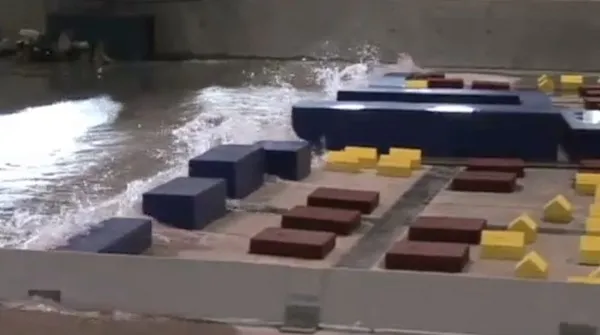
SAN FRANCISCO – Scientists have re-created an entire city in miniature to model the way a tsunami crashes onshore, and have found that buildings can exacerbate the oncoming rush of water.
The findings, presented yesterday (Dec. 3) at the annual meeting of the American Geophysical Union, show that even if a city overall tolerates the force of a massive tsunami well, certain buildings and alleyways may concentrate the rushing wave, generating 80 to 100 times the speed of waves without buildings.
"When we think about designing structures or planning for city layouts, understanding the real, detailed tsunami flow through the built environment is very, very important," said study co-author Patrick Lynett, a civil engineer at the University of Southern California.
In the 2004 Indian Ocean tsunami and the 2011 Japanese tsunami, building engineers routinely noticed that there were often two buildings standing, while one located in the middle behind it was completely washed away. Lynett and his colleagues wanted to understand why that occurred. Such an understanding is particularly important given studies showing that the West Coast is more vulnerable to tsunamis than previously thought.
To understand how a tsunami affects a coastal city, Lynett and his team created a 1:50 scale replica of the entire town of Seaside, Ore. They then flooded it with a simulated tsunami 7.9 inches (20 centimeters) high and 5 seconds long that mimicked the relative height and duration of a 200-year tsunami, Lynett told OurAmazingPlanet. [Image Gallery: Monster Waves]
As water broke over the tiny buildings, the team noticed that certain hotspots concentrated the effects of the waves. A U-shaped hotel on the coast seemed to focus the impact of the tsunami, Lynett said. "We call it the tsunami-catcher because it really amplifies the speed," he said.
Buildings arranged in a T, with two buildings in front of the wave and another building behind them, also seemed to emphasize the wave's impact.
Get the world’s most fascinating discoveries delivered straight to your inbox.
Overall, some parts of the city experienced 80 to 100 times the maximum speed and momentum that would occur without any buildings in the landscape, Lynett added. In addition to T-shaped building layouts, narrow alleyways could lead to much higher speeds of rushing water.
The findings suggest that engineers designing seaside buildings should use some of the same modeling approaches used to assess wind forces on skyscrapers, Lynett said.
"This is an argument here that, when we're trying to understand the fluid flow through a city, shadowing and concentration of fluid flow through the built environment becomes very important."
This story was provided by OurAmazingPlanet, a sister site to LiveScience. Follow OurAmazingPlanet on Twitter@OurAmazingPlanet. We're also on Facebook & Google+.

Tia is the editor-in-chief (premium) and was formerly managing editor and senior writer for Live Science. Her work has appeared in Scientific American, Wired.com, Science News and other outlets. She holds a master's degree in bioengineering from the University of Washington, a graduate certificate in science writing from UC Santa Cruz and a bachelor's degree in mechanical engineering from the University of Texas at Austin. Tia was part of a team at the Milwaukee Journal Sentinel that published the Empty Cradles series on preterm births, which won multiple awards, including the 2012 Casey Medal for Meritorious Journalism.