














Alien Life Unlikely Around Dying Stars

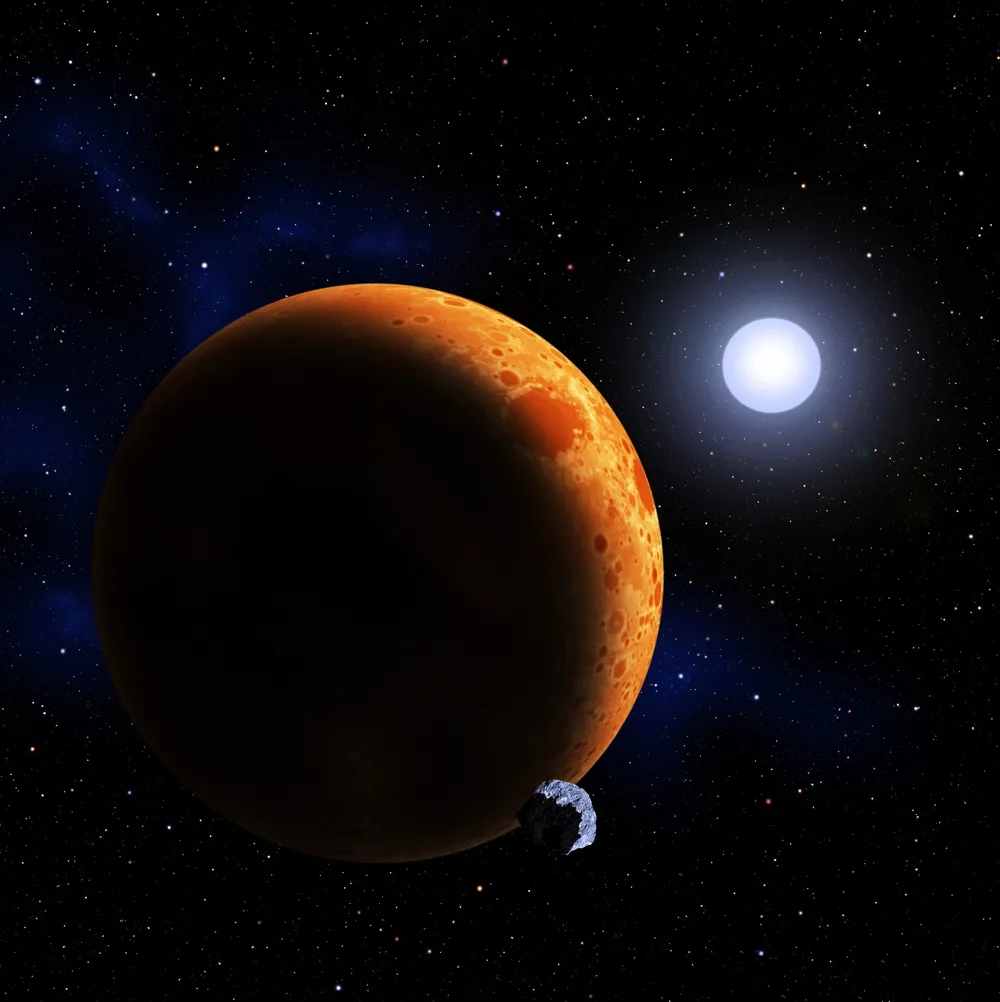
Life is unlikely to survive on exoplanets that orbit cooling stars such as white dwarfs, a new study suggests.
These stars' shifting habitable zones — the range of distances where liquid water, and perhaps life as we know it, could exist — would make it difficult for any life-forms to stick around for the long haul, researchers said.
"These planets, if we find them today in a current habitable zone, previously had to have gone through a phase which sterilized them forever," study lead author Rory Barnes, of the University of Washington, said in a statement.
"So, even if they are located in the habitable zone today, they are dead," added co-author René Heller, of the Leibniz Institute for Astrophysics Potsdam in Germany.
The study's findings apply principally to planets circling two types of celestial bodies — white dwarfs and brown dwarfs. White dwarfs are the tiny, super-dense cores of stars that have ceased undergoing nuclear fusion reactions. Brown dwarfs are "failed stars," objects bigger than planets but not massive enough to initiate stellar fusion reactions in the first place.
In theory, both white and brown dwarfs can emit enough radiation to create habitable zones around themselves. But both types of objects are cooling down, meaning their habitable zones move closer and closer in over time.
As a result, a planet that sits in a white dwarf's habitable zone today was likely within its inner edge previously. Any water the world may have possessed would probably thus have boiled off into space long ago, researchers said.
Get the world’s most fascinating discoveries delivered straight to your inbox.
This is not to say that a star has to be sunlike to potentially host life. Astronomers have already discovered several planets in the habitable zones of red dwarfs, stars that are smaller and dimmer than the sun.
Red dwarfs are the most common type of star in the Milky Way, making up perhaps 80 percent of the galaxy's stellar population. A recent study estimated that about 40 percent of red dwarfs host habitable-zone planets, suggesting that tens of billions of worlds in the Milky Way may be capable of harboring liquid water.
The new study was published this month in the journal Astrobiology.
This story was provided by SPACE.com, a sister site to Live Science. Follow SPACE.com on Twitter @Spacedotcom. We're also on Facebook & Google+.
