













'Space Buddha' Statue May Be a Fake

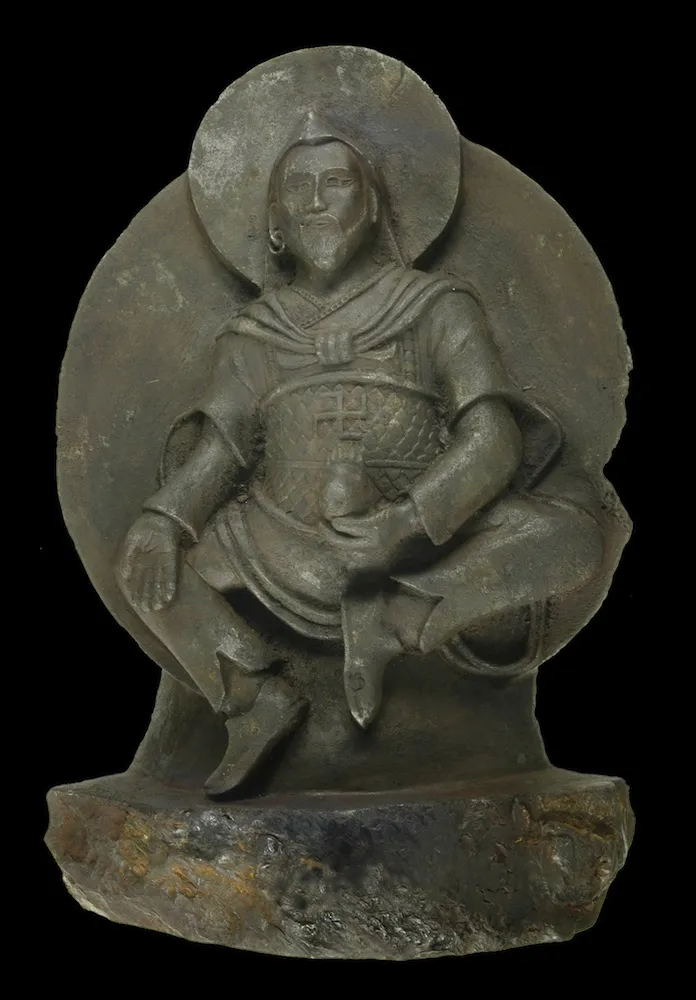
A supposed Buddhist statue allegedly carved from a meteorite 1,000 years ago may not be as ancient as suspected, according to a Buddhism expert who argues that the statue may be a 20th-century fake.
The criticisms don't target the material the statue is carved from, which is an iron- and nickel-rich meteorite from the Siberia-Mongolia border. But outside experts are questioning the statue's origins.
Achim Bayer, a expert at Dongguk University in South Korea, argues in a new report that the Buddha statue has obvious "pseudo-Tibetan features," marking it as a European reproduction likely made between 1910 and 1970.
Among these features are European-like shoes that come to the ankles rather than boots; trousers instead of robes; tube-shaped sleeves unlike those seen on traditional Tibetan or Mongolian garb; a full beard, which is not seen on Tibetan and Mongolian deity sculptures; an unusual single earring; and a cape that resembles one worn by Romans rather than ancient Tibetan deities.
In their original paper published in the journal Meteoritics & Planetary Science, Stuttgart University researcher Elmar Bucher and colleagues reported that the Buddha statue first came to Germany after a 1938-1939 Tibet expedition by zoologist and ethnologist Ernst Schäfer, who was sent to the region by the Nazi party to find the origin of Aryan language and culture. The statue then passed into the hands of a private owner. [Fallen Stars: A Gallery of Famous Meteorites]
But the researchers also warned that the estimates of the age of the statue — which they pegged around 1,000 years — were preliminary and welcomed comments by cultural scholars.
"I am happy to provide such information," Bayer wrote in his report, available online.
Get the world’s most fascinating discoveries delivered straight to your inbox.
Beyond the origins of the statue, Bayer also called into question the idea that it was brought to Germany by a Nazi expedition in the late 1930s. Isrun Engelhardt, a German historian who has studied these expeditions, told Bayer that the controversial statue likely did not arrive in Germany in Nazi hands.
Bayer suspects the statue was either produced for the antique market or for the Nazi memorabilia market, with the expedition story meant to increase the value of the statue.
Follow Stephanie Pappas on Twitter @sipappas or LiveScience @livescience. We're also on Facebook & Google+.

Stephanie Pappas is a contributing writer for Live Science, covering topics ranging from geoscience to archaeology to the human brain and behavior. She was previously a senior writer for Live Science but is now a freelancer based in Denver, Colorado, and regularly contributes to Scientific American and The Monitor, the monthly magazine of the American Psychological Association. Stephanie received a bachelor's degree in psychology from the University of South Carolina and a graduate certificate in science communication from the University of California, Santa Cruz.