













2012 Nobel Physics Prize Goes to Quantum Optics Pioneers

This story was updated at 8:22 a.m. EDT.
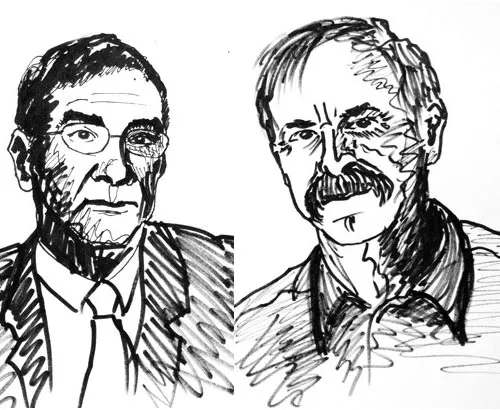
Two physicists have won this year's Nobel Prize in Physics for opening up the quantum world with experiments that probe the relationship between light and matter.
French physicist Serge Haroche and American physicist David Wineland shared the 2012 Nobel physics prize for their work on quantum optics. The prizes were announced in Sweden today (Oct. 9) just before 6 a.m. EDT (noon in Sweden). The awards will be presented there on Dec. 10.
"It's really overwhelming," Haroche said via phone during the Nobel committee's press conference announcing the prizes, adding that his first reaction was to call his children. [In Photos: Nobel Prize Winners 2012]
Haroche is a physicist at Collège de France and Ecole Normale Supérieure in Paris. He developed a technique to capture individual particles of light, called photons, by bouncing them back and forth between mirrors.
"They have been able to detect photons without destroying them. This is very hard to do," one of the Nobel Prize committee announcers said.

Wineland, based at the National Institute of Standards and Technology (NIST) and the University of Colorado-Boulder, pioneered a method to probe charged atoms (ions) with laser photons.
Get the world’s most fascinating discoveries delivered straight to your inbox.
"David Wineland has achieved extraordinary control over the states of an ion," another Nobel committee member said.
His discoveries have led to the development of one of the most precise clocks ever made, and could mark the first steps toward building a quantum computer, which would use tiny quantum systems to make calculations much quicker than normal computers.
"Serge Haroche and David J. Wineland have independently invented and developed methods for measuring and manipulating individual particles while preserving their quantum-mechanical nature, in ways that were previously thought unattainable," Nobel officials wrote in a statement.
The two researchers have taken different tacks to study some of the same phenomena, and their work is complementary, Nobel officials said. They will share the 8 million Swedish kronor prize ($1.2 million).
Both physicists were informed of their win this morning. "I was walking with my wife," Haroche said of getting the call. "When I saw the [Swedish] area code, then I sat down." He said he planned to celebrate the honor with some lunchtime champagne, and then go back to the office.
The call came to Wineland in Colorado in the middle of the night.
"I was sleeping and my wife got the call and woke me up," Wineland told a Nobel Prize interviewer during a recorded call this morning. He called the news "a wonderful surprise of course. Just amazing."
"We probably won't go back to sleep for a while," he added.
You can follow Clara Moskowitz on Twitter @ClaraMoskowitz or LiveScience @livescience. We're also on Facebook & Google+.
