














Alternative Fuel Rocket Roars to Life in Test

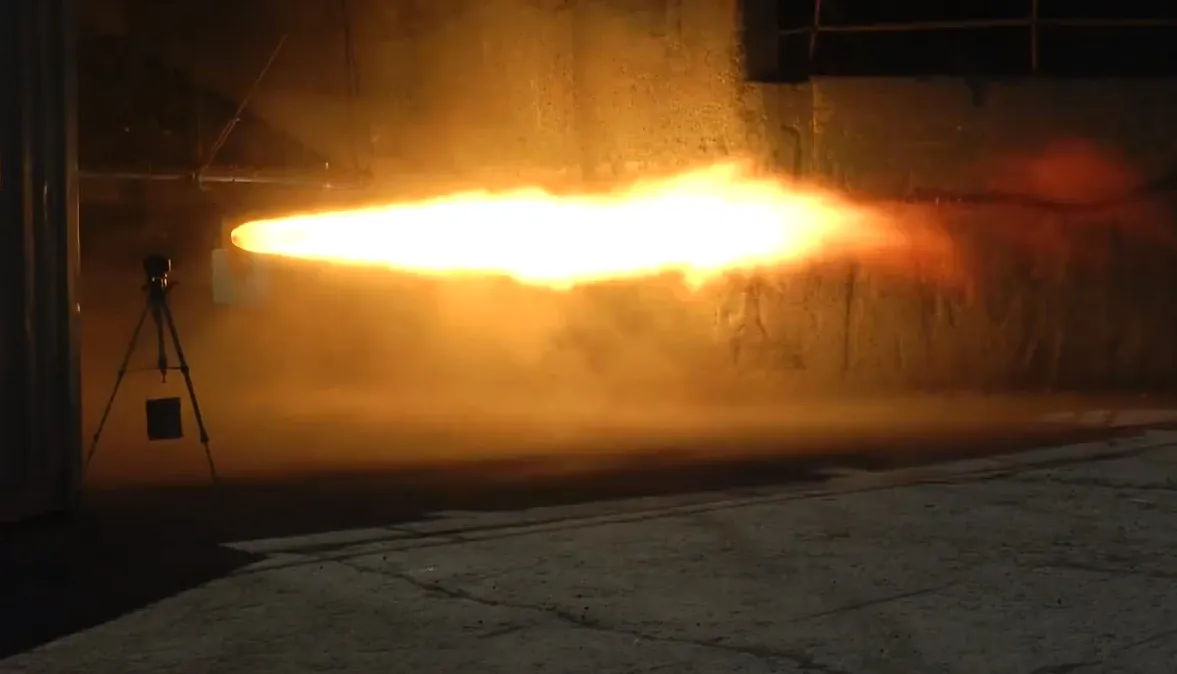
A new hybrid rocket motor fired up Friday (June 29), demonstrating technology that its builders say could lead to efficient, alternative-fuel launch vehicles down the road.
California-based Space Propulsion Group, Inc. (SPG) test-fired the 22-inch-wide (56-centimeter) liquid oxygen/paraffin motor for about 20 seconds Friday, blasting a streak of bright flame into the air at the company's testing facility in Butte, Mont.
The trial was the fifth for this particular motor, SPG officials said, and it demonstrated a flight-weight version of the design.
The company says future propulsion systems using the motor's hybrid technology have the potential to be five to 10 times cheaper than existing rockets. And the paraffin fuel has the added benefit of being non-toxic, officials said.
"We believe propulsion drives the cost of access to space and that complexity generally drives propulsion system cost," SPG president and chief technical officer Arif Karabeyoglu said in a statement after the test-fire. "By using a commercially available paraffin-based fuel, we have created an economically viable alternative that could significantly reduce the price of space accessibility, as well as help preserve the environment."
Hybrid rocket motors use propellants that are in two different states of matter, as opposed to purely liquid or solid rockets.
Proponents of hybrid technology claim that it combines the advantages of the other two types, offering the simplicity of solid systems and the safety of liquid rockets. (Solid rockets, such as the boosters that helped loft NASA's now-retired space shuttle, generally can't be shut off once they've been lit.)
Get the world’s most fascinating discoveries delivered straight to your inbox.
Hybrid rockets are playing a large role in the burgeoning private spaceflight industry. Virgin Galactic's suborbital SpaceShipTwo vehicle employs hybrid motors, as does Sierra Nevada's Dream Chaser, a mini-shuttle that's in the running to transport NASA astronauts to and from the International Space Station.
This story was provided by SPACE.com, a sister site to LiveScience. Follow SPACE.com on Twitter @Spacedotcom. We're also on Facebook and Google+.
