













Striking Photo Reveals Dark Side of Sunshine

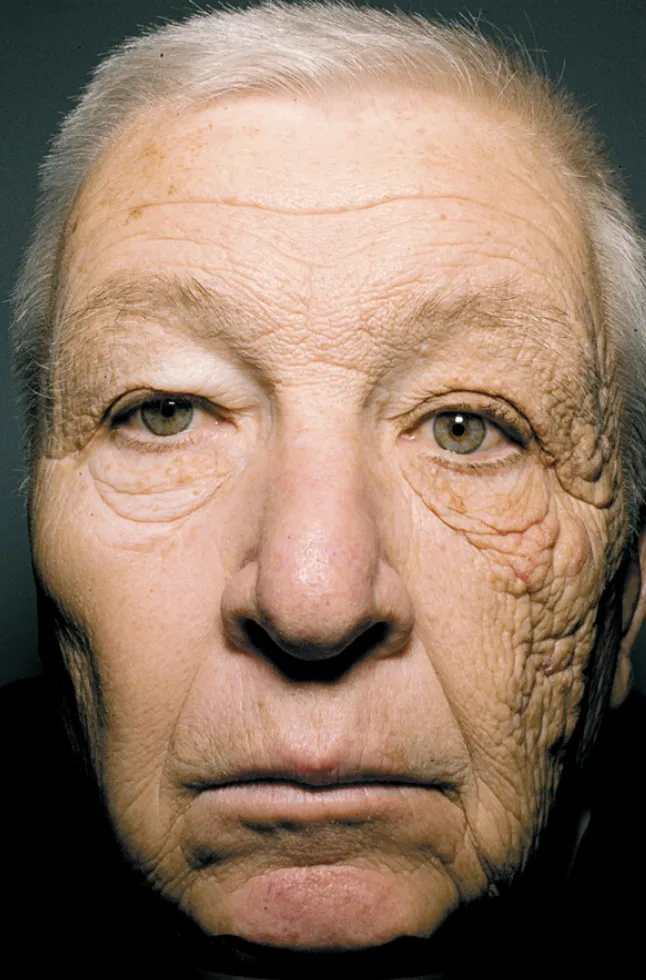
A new striking image of a 69-year-old truck driver shows just how much damage the sun can do.
This photograph, published in the New England Journal of Medicine, shows what dermatologists call dermatoheliosis — sun damage, a common sign of aging. What makes it striking is that this man, a retired truck driver, shows the damage on only one side of the face.
"He was a truck driver for the majority of his life and never wore sunscreen," said Northwestern University dermatologist Jennifer Gordon, who reported the man's case. "We think the sun exposure just on this side of the face is what caused the damage."
Ultraviolet A (UVA) light from the sun can easily penetrate window glass and even light clothing, Gordon told LiveScience. UVA rays cause damage deep in the skin, affecting connective tissues such as collagen and elastin.
"That's where you get that aging effect: the wrinkles, the deposits of material in the skin," Gordon said.
The patient in the photograph came to Gordon and her colleagues after he got tired of his grandchildren asking him what was wrong with one side of his face. So far, the man has not exhibited any signs of skin cancer, Gordon said, though he'll need to be monitored carefully in the future.
The best way to prevent skin cancer as well as early aging is sunscreen, Gordon said. The American Academy of Dermatology (AAD) recommends using sunscreens that provide a sun protection factor (SPF) of at least 30, and that offer broad-spectrum protection against both UVA and UVB rays. UVB rays are the primary cause of sunburn. While UVB rays are blocked by window glass, UVA rays are not; even on a cloudy day, up to 80 percent of the sun's UV rays make it through the clouds. The AAD recommends wearing sunscreen on exposed areas of the skin daily, even during winter.
Get the world’s most fascinating discoveries delivered straight to your inbox.
"The biggest thing I've probably learned from this is that you're never safe from the sun," Gordon said.
You can follow LiveScience senior writer Stephanie Pappas on Twitter @sipappas. Follow LiveScience for the latest in science news and discoveries on Twitter @livescience and on Facebook.

Stephanie Pappas is a contributing writer for Live Science, covering topics ranging from geoscience to archaeology to the human brain and behavior. She was previously a senior writer for Live Science but is now a freelancer based in Denver, Colorado, and regularly contributes to Scientific American and The Monitor, the monthly magazine of the American Psychological Association. Stephanie received a bachelor's degree in psychology from the University of South Carolina and a graduate certificate in science communication from the University of California, Santa Cruz.