














Earth's Core Starved for Oxygen

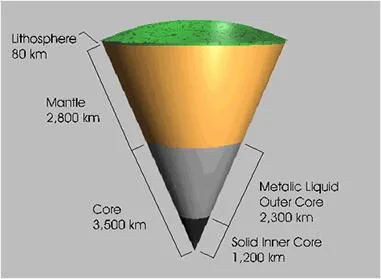
The Earth's intensely hot and super-pressurized core is even harsher than scientists realized, according to a study published today in the journal Nature.
Oxygen does not have a major presence in the outer core, according to the new research. This has major implications for scientists' understanding of the period when the Earth formed through the accretion of dust and clumps of matter.
The composition of the Earth's core remains a mystery — just last year scientists found it has another layer. Scientists know that the liquid outer core consists mainly of iron, but it is believed that small amounts of some other elements are present as well. Oxygen is the most abundant element on the planet, so it is not unreasonable to expect oxygen might be one of the dominant "light elements" in the core. But that's not so, the new research says.
Which light element?
Computer models had predicted the light elements to include sulfur, oxygen, silicon, carbon and hydrogen. In the new research, a team from the Carnegie Institution's Geophysical Laboratory narrowed the list of possible light elements present in Earth's outer core.
With increasing depth inside the Earth, the pressure and heat also increase. As a result, materials act differently than they do on the surface. At Earth's center are a liquid outer core and a solid inner core. The light elements are thought to play an important role in driving the convection of the liquid outer core, which generates the Earth's magnetic field.
Scientists know the variations in density and speed-of-sound as a function of depth in the core from seismic observations, which gives them some idea of the different makeup of core materials, but to date it has been difficult to measure these properties in proposed iron alloys at core pressures and temperatures in the laboratory.
Get the world’s most fascinating discoveries delivered straight to your inbox.
"We can't sample the core directly, so we have to learn about it through improved laboratory experiments combined with modeling and seismic data," said study team member Yingwei Fei of Carnegie.
High-speed impacts
High-speed impacts can generate shock waves that raise the temperature and pressure of materials simultaneously, leading to melting of materials at pressures corresponding to those in the outer core. The team carried out shock-wave experiments on core materials, mixtures of iron, sulfur and oxygen. They shocked these materials to the liquid state and measured their density and the speed of sound traveling through them under conditions directly comparable to those of the liquid outer core.
By comparing their data with observations, they concluded that oxygen cannot be a major light element component of the Earth's outer core, because experiments on oxygen-rich materials do not align with geophysical observations. This supports recent models of core differentiation in early Earth under less oxygen-heavy environments, leading to a core that is poor in oxygen.
"The research revealed a powerful way to decipher the identity of the light elements in the core. Further research should focus on the potential presence of elements such as silicon in the outer core," Fei said in a statement.
This story was provided by OurAmazingPlanet, a sister site to LiveScience. Follow OurAmazingPlanet for the latest in Earth science and exploration news on Twitter @OAPlanet and on Facebook.
