
 Live Science Plus


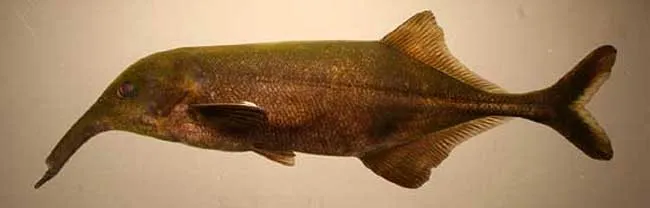
What's not to love about elephantfishes? Not only do they have extended jaws resembling their namesakes' trunks — they're electric! Modified muscle cells near their tails discharge pulses of electricity into the water.
The fish use the resulting electric field to detect nearby objects, a useful trick in the murky African rivers they inhabit. They also use the pulses — which can vary in strength, frequency, and duration — to communicate with one another and, as a recent study shows, to recognize mates of their own species. In a laboratory at the University of Potsdam in Germany, Philine G.D. Feulner and colleagues exposed ready-to-spawn female Campylomormyrus compressirostris elephantfish to different computer-simulated pulses. At one end of the tank, the pulses mimicked a male of the same species; at the other end, they mimicked a closely related species that occupies the same habitat. The pulses of the related species last a hundred times longer than those of any self-respecting C. compressirostris — and sure enough, the females shunned them. Feulner and her team say that female preference for certain electric signals may be what led the two elephantfish species to separate. Alternatively, other factors may have caused the original rift, with a discriminating taste in sparks evolving later, perhaps owing to the high costs of mating with the wrong species.
