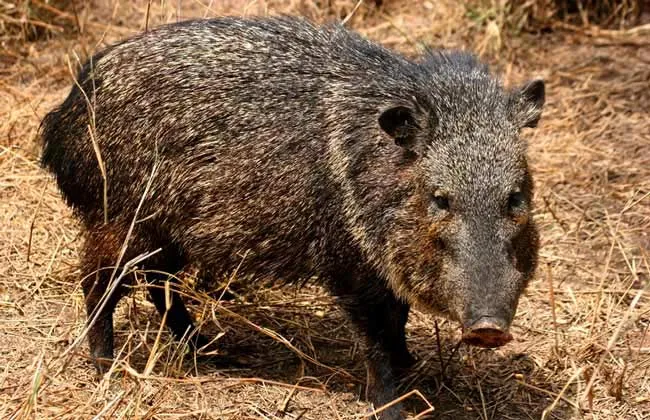
To find me twenty years ago, you might have looked under a Mexican blue oak in the mountains of southern Arizona. From there I would often watch javelinas wander among shin dagger agave in open stretches of juniper and oak woodland. They would gnaw on the yellow flame of flowers and the spiny hearts of the agave. I'd once heard that Napoleon used pigs to test his food for poison. If a pig could eat it, the story went, the meal was deemed safe for Bonaparte. So, perhaps I could eat the agave?
But javelinas, also known as collared peccaries, are not pigs. They belong to another family of cloven-hoofed ungulates — something between pigs and hippos — that is native to the Americas. True pigs came from Asia, Europe, and Africa. If I had known some of the differences at the time, like the fact that javelinas have more complex stomachs than true pigs, I wouldn't have been so eager to try the javelinas' fare.
Since I was already supplementing my diet with what the local bears and birds eat — cactus fruit, acorns, manzanita berries — I decided to venture into the shin dagger agave. The spines stabbed my shins and ankles, leaving small spots of blood at the puncture sites, which later festered and ejected pencil-point splinters. I cut out the juicy, white pulp of one agave, and when I chewed it, I gasped. The fluid released was so caustic it burned mouth and throat. Yet it cleared my sinuses and left a pleasant sense of menthol. With vision in the range of the legally impaired, javelinas depend upon their exceptional sense of smell. So when downwind of them in the nighttime dark, I've blundered into their midst. Their sharp, muffled grunts crackle like distant cannon fire. In the gray light, I would see their coarse fur bristle and feel my own hackles rise. Then one would snuffle, catching my scent, and send them clattering in all directions, bumping me in a blind rush to escape.
Latest Videos From
At first, javelinas all smelled vaguely like skunk to me. Herd members will rub their throats against scent glands on one another's rumps, so each member of a given herd wears a community scent. One morning near a pool shaped like a crow's foot, I smelled coffee. I looked for a shrub called Wright's silktassel or bearberry, which emits a coffeelike scent when brushed against, but I found none. I looked for a campfire — nothing. I smelled coffee several more times, always in that area, and slowly realized that I had found a coffee-scented herd. The familiar coffee scent made me more aware of nuances in the scents of other herds. I was soon able to distinguish one that bore the more skunklike scent, and another whose scent was sweeter.
One evening at dusk I came across a dead javelina on the road. I grabbed a fistful of coarse gray hair to pull the still-warm body aside and clear the way; it was heavier than I expected. I lifted it by its hindquarters, dragging the head with its long, tusklike canine teeth, behind. My shirt was pressed against its rump gland.
Ninety minutes later, in a flat stretch of prickly pear above the crow's-foot pool, I found myself surrounded by javelinas. As my miner's light moved from one pair of red-glowing eyes to the next, they stood their ground, snouts raised, nostrils flared and twitching, the fur on their backs rippling. They've caught the scent of the foreign javelina, I thought. Suddenly they rushed at me — hot flanks against my bare legs — making me sway as they came in from all sides, veered past, and turned to charge again. I feared that they'd knock me down, trample me with their sharp hooves, rip me to pieces with their long canines.
No deathblow came. They jostled me until I had retreated to the ridge that marked the edge of their territory. I stood on shaky legs as their hoofbeats faded into the lower distance. Yet now I am at ease among javelinas, knowing the quality of their attack.
Walker Thomas spent about eight years exploring the mountains of southern Arizona. He wrote of those years in "Notes from a Solitary Beast," in Tucson's City Magazine in 1987, and about his trips to town during that time in "The Commute,"(Outside, 1988).

 Live Science Plus