This ScienceLives article was provided to LiveScience in partnership with the National Science Foundation.
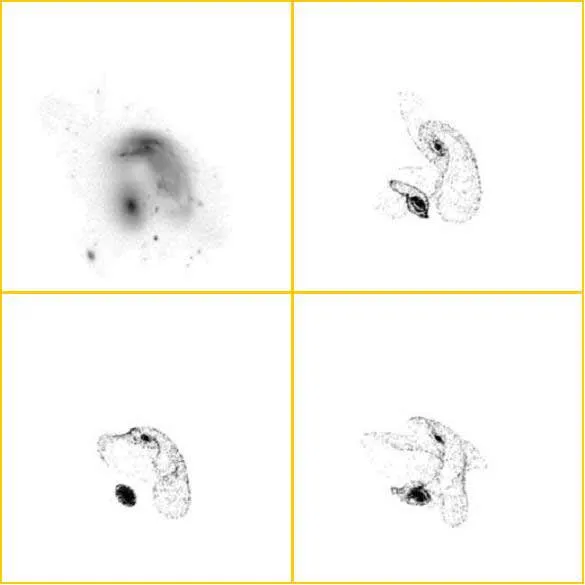
John Wallin is a Computational Scientist in George Mason University's Department of Computational and Data Sciences. His work centers on complex problems where a computation plays a central role in simulation or data analysis. The primary focus of his work has been understanding the physical processes of galaxy mergers, including the resulting star formation and nuclear activity. This work has combined both large data sets and complex numerical codes. Wallin's most recent work has centered on the Zooniverse project, helping to enable citizen scientists to participate in complex scientific analysis. He is the project lead for "Galaxy Zoo: Understanding Cosmic Mergers," where thousands of volunteers are reviewing and creating possible models of interacting galaxies. In addition to his research work, Dr. Wallin is the undergraduate coordinator of George Mason's new undergraduate program in Computational and Data Sciences. Students in this program learn how to use computing to solve scientific problems. He has supervised five dissertations, and currently is working with three new doctoral students. Wallin and his wife Katharine live in Fairfax, Va. with their three cats, Dumbledore, McGonnagall and Hagrid. Outside of the academy, Wallin volunteers with the American Red Cross as the captain of the disaster response team for North Fairfax County. He also volunteers with the Civil Air Patrol (The US Air Force Auxillary) in coordinating search and rescue missions for missing aircraft. On weekends during the summer, he can usually be found flying his sailplane out of Frederick, Md. Below, he answers the ScienceLives 10 Questions.
Name: John Wallin Age: 48 Institution: George Mason University Field of Study: Computational Science
Latest Videos From
What inspired you to choose this field of study? When I was 4, I wanted to be an astronaut. When I turned 5, I decided to become an astronomer. In high school, I worked as a programmer writing educational simulations on the Apple II. I found out I could combine my interests in computing and astronomy, and now I work as a computational scientist who solves science problems using computers.
What is the best piece of advice you ever received? It's OK to make mistakes as long as you learn from them.
What was your first scientific experiment as a child? I did so many that I can't remember the first one. As a kid, I had geology, chemistry and electricity labs set up in my basement. I remember making baking soda and vinegar rockets and shooting them in the basement when I was in grade school. I also remember hooking up light bulbs, batteries and switches.
What is your favorite thing about being a scientist or researcher? I love the freedom to explore new ideas. In my job, I discover new things that no one has ever thought of before and build software that helps understand the universe. I work with interesting and smart people. Almost every day, I am happy to go to work.
What is the most important characteristic a scientist must demonstrate in order to be an effective scientist? Persistence. You don't have to be the smartest kid in your school to be a scientist, but you have to be able to keep working on problems even when things get tough. I have seen lots of brilliant people wanting to become scientists, but the ones who do the best in science are those who can focus and work hard.
What are the societal benefits of your research? My research enables volunteers to help solve difficult scientific problems through the Zooniverse project. The analysis tasks we are asking for involve image recognition and perception tasks that computers can't do accurately. The citizen scientists that participate in our project are amazing. They have helped solve problems that we could never address on our own. In the process, they have become better scientists themselves and have become more aware of how science works.
The astronomy questions our volunteers have helped answer have given us a better understanding of the universe. This cosmic connection is something that can't be quantified, but it gives us a unique perspective on the world and those around us. We hope our volunteers gain this connection, and see that our world is a special place in the universe.
The practical consequences of my research will be new ways to train computers how to recognize images and patterns. As data sets grow larger, computers need to grow smarter.
Who has had the most influence on your thinking as a researcher? It wasn't one single person. I had excellent mentors throughout my education and my career — excellent teachers like Don Penn, Dale Gibbs, Larry Mascotti, Steve Kipp, James Pierce and Curt Struck all played key roles. I can't thank them enough for what they did.
What about your field or being a scientist do you think would surprise people the most? Most people don't know that Computational Science exists! I constantly have to explain to people what computational science is. We are facing huge problems in science where computer simulations play a critical role. In the next few years, many experiments across the sciences are going to generate terabytes of data every hour. There is a huge need for new computational scientists to deal with these problems, but almost no one has even heard of my field.
If you could only rescue one thing from your burning office or lab, what would it be? When I was on sabbatical at Los Alamos, I had to drive into the city to rescue my graduate student from a forest fire. I was living in Santa Fe, and my student was in Los Alamos. Since he didn't have a car, I drove up to get him out of the city during the mandatory evacuation. We ended up having the student and three other friends stay in our home for about a week until it was safe to return. I now volunteer with the Red Cross to help other people recover from disasters and fires.
I have backups of my data, programs, and pictures at my home, so I would grab my Teaching Excellence Award if I could take only one thing out of my office. I really value my teaching, and I am very proud of my award.
What music do you play most often in your lab or car? My radio is usually set on modern rock stations. However, I listen to a lot of classic rock and pop. My current favorite artists on my iPod are Jimmy Buffet, Weird Al, the Beatles and Kelly Clarkson.
Editor's Note: This research was supported by the National Science Foundation (NSF), the federal agency charged with funding basic research and education across all fields of science and engineering. Any opinions, findings, and conclusions or recommendations expressed in this material are those of the author and do not necessarily reflect the views of the National Science Foundation. See the ScienceLives archive.