 Live Science Plus





You are now subscribed
Your newsletter sign-up was successful
Want to add more newsletters?

Delivered Daily
Daily Newsletter
Sign up for the latest discoveries, groundbreaking research and fascinating breakthroughs that impact you and the wider world direct to your inbox.

Once a week
Life's Little Mysteries
Feed your curiosity with an exclusive mystery every week, solved with science and delivered direct to your inbox before it's seen anywhere else.

Once a week
How It Works
Sign up to our free science & technology newsletter for your weekly fix of fascinating articles, quick quizzes, amazing images, and more
Delivered daily
Space.com Newsletter
Breaking space news, the latest updates on rocket launches, skywatching events and more!

Once a month
Watch This Space
Sign up to our monthly entertainment newsletter to keep up with all our coverage of the latest sci-fi and space movies, tv shows, games and books.

Once a week
Night Sky This Week
Discover this week's must-see night sky events, moon phases, and stunning astrophotos. Sign up for our skywatching newsletter and explore the universe with us!
Join the club
Get full access to premium articles, exclusive features and a growing list of member rewards.
The lakes that form atop Greenland's Ice Sheet, called supraglacial lakes, can rapidly, and mysteriously, drain billions of gallons of water in a matter of hours. Geoscientists have now figured out a key part of the puzzle to explain how this vanishing act occurs. They published their results today (June 3) in the journal Nature. [Read the full story on Greenland's supraglacial lakes]
Here one day ...

In 2006, North Lake in Greenland, a supraglacial lake, drained nearly 12 billion gallons of its meltwater in less than two hours. Scientists later found that giant water-induced cracks called hydro-fractures can form just beneath the lake basin, stretching down to the bed of the ice sheet. Those cracks can empty the overlying lake of its water. Here, a moulin (vertical conduits or shafts in a glacier) formed along the hydro-fracture through Greenland's North Lake basin continues to drain meltwater to the bed after the 2013 North Lake rapid drainage. (Photo Credit: Ian Joughin)
Icy mystery

Scientists weren't sure just how these fractures developed — until now. In the new study, scientists used 16 GPS stations placed around North Lake to figure out specific movements below the lake. They found that tension-related stress caused by movements of the ice sheet (triggered by the trickling meltwater) could create these hydro-fractures. The rapid drainage of North Lake in 2011 left behind a hydro-fracture scarp and exposed lakebed (shown here). (Photo Credit: Ian Joughin)
On the move

The new finding also paints a clearer image of the meltwater that travels down to the bed of the Greenland Ice Sheet, helping scientists to figure out how fast that sheet flows during the summer months, the researchers said. Here, a supraglacial lake on the western margin of the Greenland Ice Sheet. (Photo Credit: Laura A. Stevens)
Summer melt
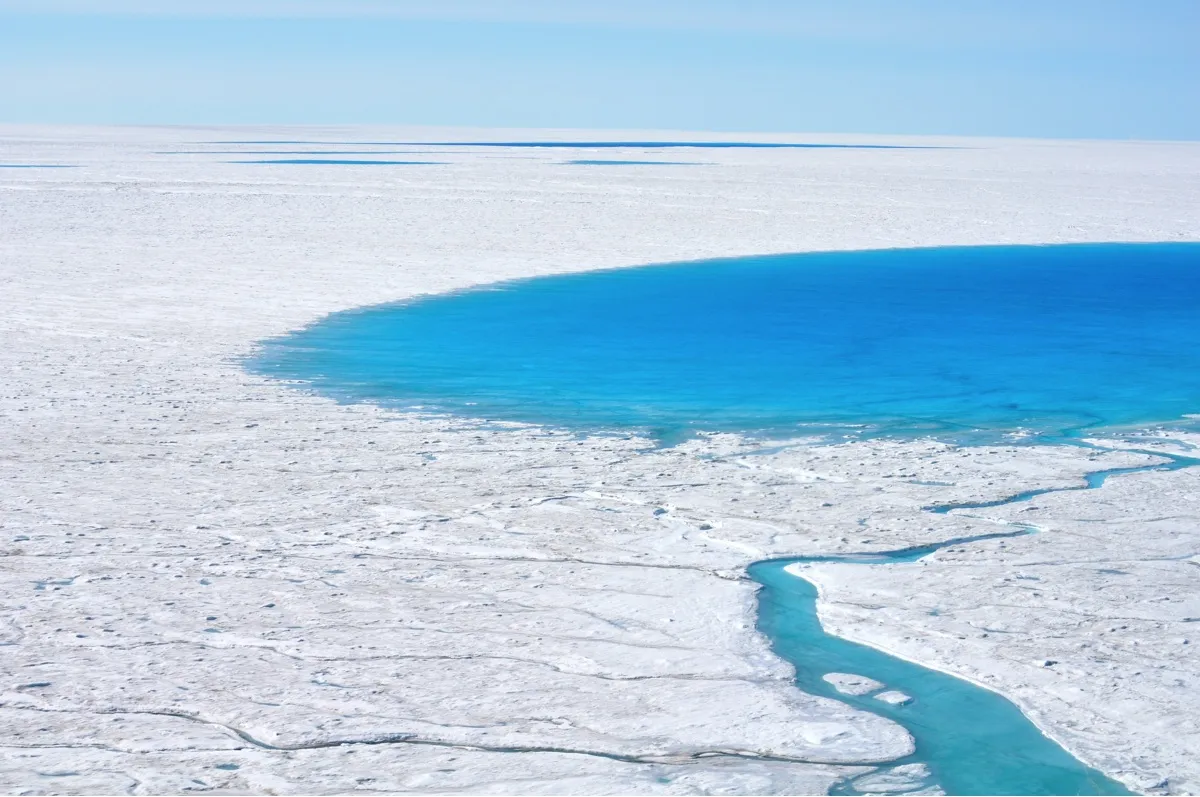
Supraglacial lakes, like this one on the western margin of the Greenland Ice Sheet, form atop the ice sheet during the summer "melting" months. (Photo Credit: Laura A. Stevens)
Disappearing acts

A supraglacial lake and helicopter on the western margin of the Greenland Ice Sheet. Most of these lakes drain slowly as streams pop up and send that water into permanent crevasses. However, recent research using satellite images has suggested 13 percent of lakes "disappear" within 24 hours, completely draining. (Photo Credit: Laura A. Stevens)
Hydrologic pipeline
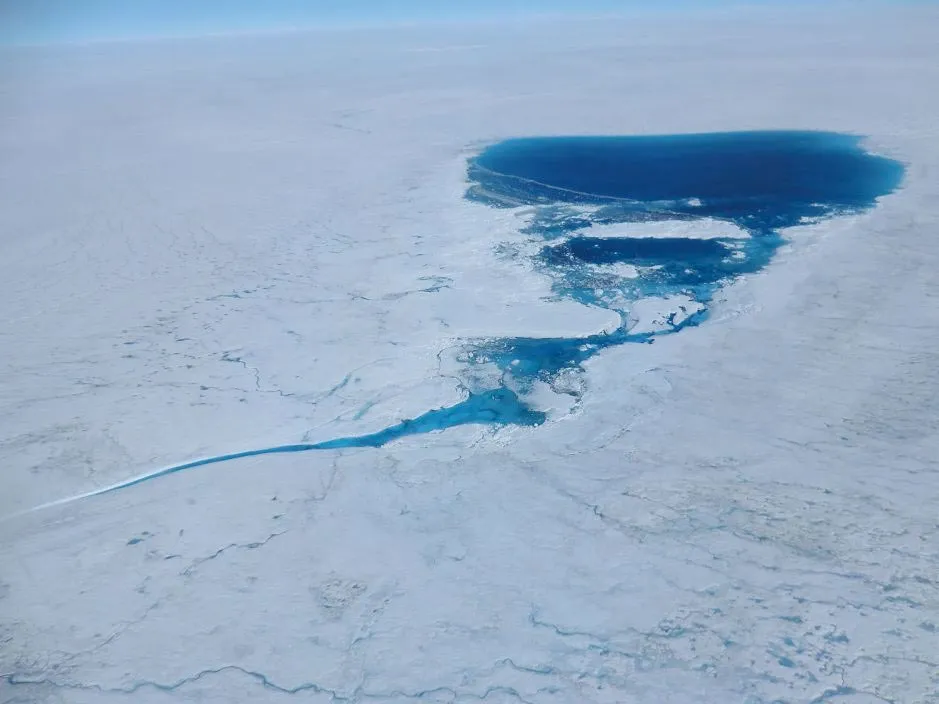
Here, a supraglacial lake on the Greenland Ice Sheet in the Kangerlussuaq area. Photographed on July 21, 2012, the lake feeds a stream that delivers meltwater to the low elevations where it either flows to the ocean on the surface or dives into the ice to contribute to a hydrological pipeline of sorts. (Photo Credit: Marco Tedesco)
Follow us @livescience, Facebook & Google+.
