















Image Gallery: Inscriptions Reveal Life at a Quarantine Station

Hopeful engraving
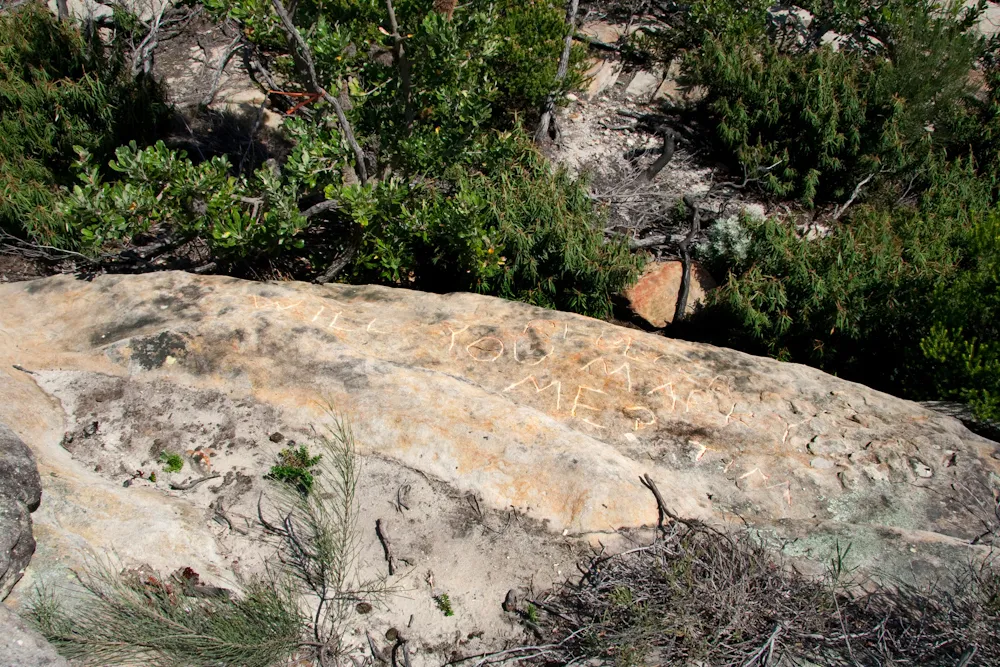
Discovered on a sandstone outcrop, just south of a decommissioned quarantine station, this carving reads "Rebecca will you marry me? Tim." Archaeologists don't know who the couple was, or if Rebecca accepted Tim's proposal. Judging by the lack of patination they believe it was made within the past 10 years.
Recent request

An up close view of the marriage proposal. Carved in large letters it is several feet across. The inscription was likely created after the quarantine station was closed and incorporated into a park.
Beauty and history

A view of the decommissioned quarantine station today with a humpback whale passing by. It was in operation for over 150 years and was the final resting place for more than 500 people who never made it out alive. Today it's an important Australian heritage site and its original buildings can be seen close to the beach.
Ancient artistry

The artistry of some of the inscriptions carved near the station is incredible. Shown here are two heavily weathered heads carved in the shape of "medallions." The one at left appears to depict a sailor.
First man

A carving of a Tiki. It represents a humanoid being, popular in Polynesia, who is considered by some cultures to be the first man.
The lost

This carving was created by John Howie, a stonemason from Scotland. On June 11, 1879 the ship he was on, the Samuel Plimsoll, arrived in quarantine. Historical records show that 12 people died on the journey including Howie's infant son William. The inscription lists five of the ship's senior staff but notably leaves out the name of the surgeon Pringle Hughes.
The dear

This more informal inscription was also carved by John Howie. The name Mary Howie is of a 16 year-old servent, possibly his sister. The A. Howie may stand for John's wife Agnes, it may also stand for Archibald Howie, a 25 year-old stonemason who may have been John's brother. Fairfoull and Reid may have been close friends of the family.
Get the world’s most fascinating discoveries delivered straight to your inbox.
The little things

This inscription is dated October 1895 and was created by someone from the RMS Cuzco. It reads "in loving memory of Irish stew." Researchers don't know if this refers to a person nicknamed "Irish stew" or whether someone really missed eating the dish itself.
Hard at work

Researchers at work uncovering and recording an inscription. Throughout its 150 years of use nearly 1000 inscriptions were created near the quarantine station.
In view of hope

Inscriptions carved near the edge of a cliff with Sydney's skyline in the distance.
