













Antarctic Album: Chinstrap Penguins of Deception Island
Deception Island

Andres Barbosa of the National Museum of Natural Sciences in Madrid and his team have been studying the chinstrap penguins of Deception Island since 1999. Its volcanic origins have shaped the island into a horseshoe shape, with the volcano's caldera at the center. The island is one of the most visited of Antarctica, drawing some 25,000 visitors in the year 2007-08.
Chin Strap
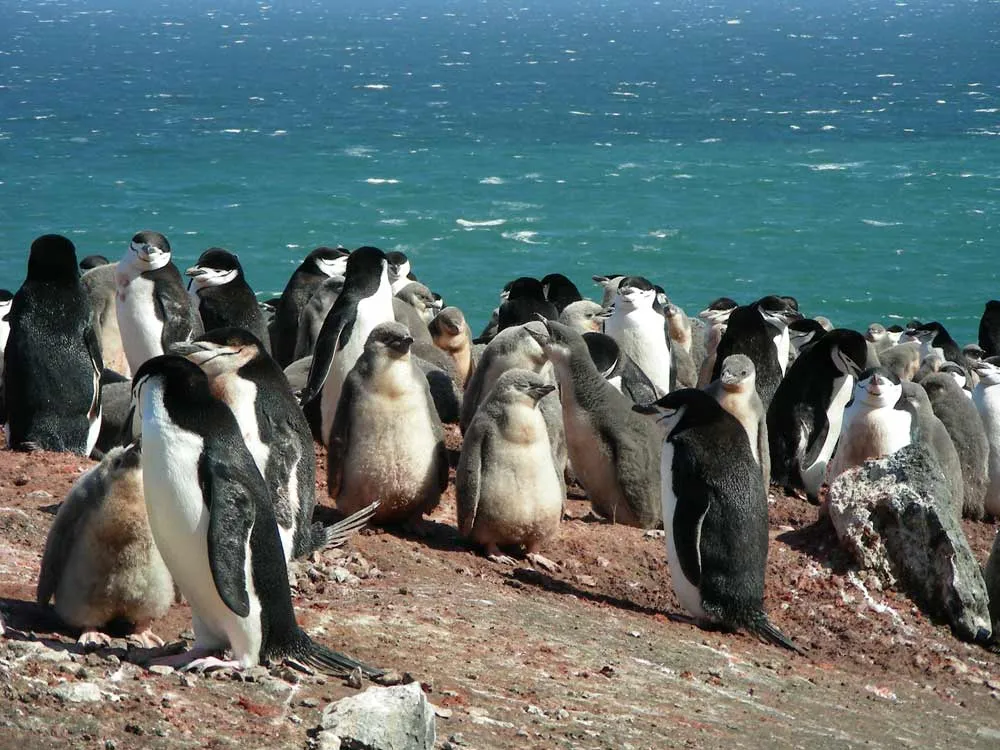
Named for the thin black band of feathers that extends from ear to ear under their heads, chinstrap penguins grow to about 2.2 feet (68 centimeters) tall, with males being larger and heavier than females.
Find the Mate

Monogamy between chinstrap penguin couples often persists from year to year, with pairs even using the same nesting sites in successive years. To make sure they've got the right mate, the penguins use certain mate-recognition behavior, seen here between a pair of chinstraps, which involves the penguins pumping their chests and stretching their heads upward.
Little Nests

Female chinstrap penguins form a circular platform nest with a shallow interior. The nests are roughly about 16 inches (40 cm) across and up to 6 inches (15 cm) high.
Two Chicks

The female usually lays two eggs in a shallow nest in late November, with each of the pair participating in incubation duties. The chicks hatch after about 33 to 35 days.
Chick Huddle

Typically, fledgling occurs at about 7 to 8 weeks, with the chinstrap penguin chicks eventually forming crèches, or groups of young penguins that huddle together for warmth and protection. Then, at about 50-60 days old, once the chicks have molted, they head out to sea.
Penguin Team

The penguin team, including Barbosa, shown here with chinstrap penguins on Deception Island.
Get the world’s most fascinating discoveries delivered straight to your inbox.
Nest Checks

The researchers tallied the occupied nests on the island in 1991-92 and 2008-09. Here they are checking chinstrap nests. (They also used photographic evidence for nest counts.)
Little Beaks

Researchers measure the beak of a chinstrap penguin on Deception Island.
Penguins Plummet

The researchers found occupied nests on the island have declined by about 36 percent between 1991 and 2008.
Main Food

The culprit for the decline is likely a loss of their main prey, tiny shrimplike creatures called krill. The krill eat algae that attach to the sea ice, so without sea ice the krill plummet, followed by a decline in chinstrap penguins.
Jeanna Bryner is managing editor of Scientific American. Previously she was editor in chief of Live Science and, prior to that, an editor at Scholastic's Science World magazine. Bryner has an English degree from Salisbury University, a master's degree in biogeochemistry and environmental sciences from the University of Maryland and a graduate science journalism degree from New York University. She has worked as a biologist in Florida, where she monitored wetlands and did field surveys for endangered species, including the gorgeous Florida Scrub Jay. She also received an ocean sciences journalism fellowship from the Woods Hole Oceanographic Institution. She is a firm believer that science is for everyone and that just about everything can be viewed through the lens of science.