













A mysterious 'hum' vibrates interstellar space. Voyager 1 has a recording of it.
Interstellar plasma is vibrating out there past the edges of the solar system.

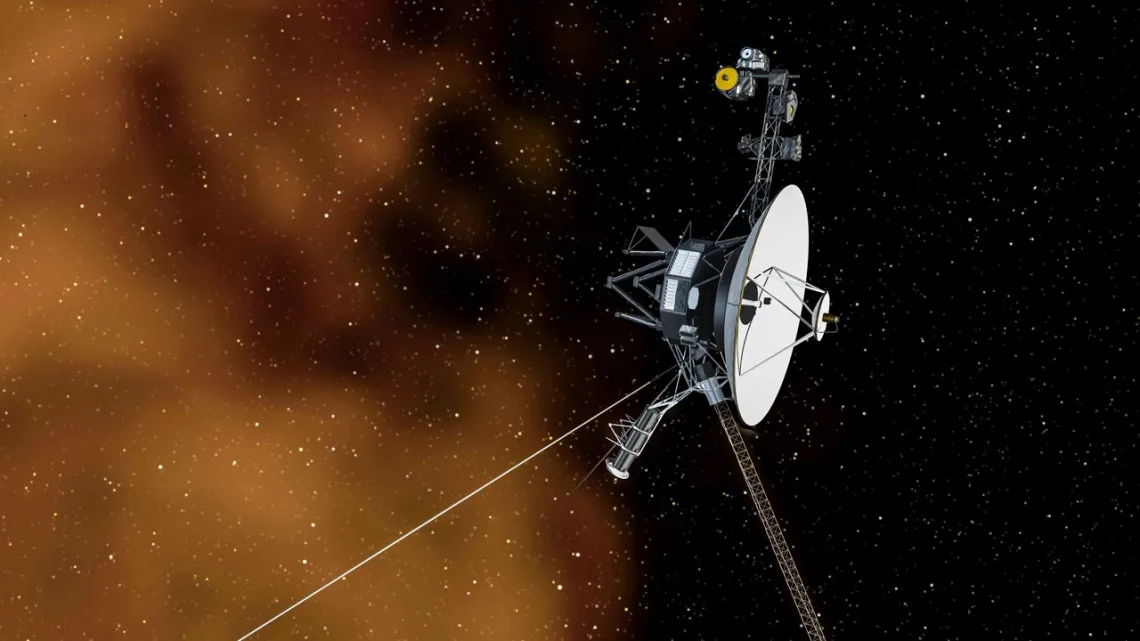
Forty-four years after it rocketed off from Earth, the Voyager 1 spacecraft is detecting the background "hum" of interstellar space for the first time.
Voyager 1, launched in 1977, left the bounds of the solar system — known as the heliosphere — in 2012. The heliosphere is the bubble of space influenced by solar wind, the stream of charged particles that emanates from the sun. Since popping out of this bubble, Voyager 1 has been periodically sending back measurements of the interstellar medium. Occasionally, the sun sends off a burst of energy known as a coronal mass ejection that disturbs this medium, causing the plasma, or ionized gas, of interstellar space to vibrate. These vibrations are quite useful, as they allow astronomers to measure the density of the plasma — the frequency of the waves through the plasma can reveal how close together the ionized gas molecules are.
Now, though, researchers have realized that Voyager 1 is also sending back a far more subtle signal: the constant "hum" of the interstellar plasma. This low-level vibration is fainter, but much longer-lasting, than the oscillations that occur after coronal mass ejections. According to the new study, published May 10 in the journal Nature Astronomy, the hum lasts at least three years. That's good news for gaining a better understanding of the interstellar plasma.
Related: 11 strange and mysterious sounds on Earth and beyond
"Now, we don't have to wait for a fortuitous event to get a density measurement," said study leader Stella Ocker, a doctoral student in astronomy at Cornell University. "We can now measure the density almost continuously."
Voyager 1 is currently almost 153 astronomical units from the sun. An astronomical unit is the distance between the sun and Earth, so that means that the antennae-studded spacecraft is now 153 times as far away as Earth is from the sun. The craft was one of a pair originally designed to fly by Jupiter, Saturn, Uranus and Neptune, taking advantage of a rare planetary alignment that would allow Voyager 1 and 2 to use the gravity of each planet to propel themselves to the next, according to NASA's Jet Propulsion Laboratory.
Both Voyager 1 and 2 are still transmitting from interstellar space (Voyager 2 made it past the heliosphere in 2018). Ocker and her colleagues combed through data from the last five years of Voyager 1's transmissions to find the subtle hum of interstellar space. They were surprised to find that the vibrations occur on a narrow set of frequencies, unlike the vibrations from the coronal mass events, which tend to show up more broadly, Ocker told Live Science.
Get the world’s most fascinating discoveries delivered straight to your inbox.
RELATED CONTENT
The researchers don't yet know exactly what causes the low-key plasma vibration, but it probably has to do with the "jitter" of electrons in the medium due to their basic thermal properties, Ocker said.
Having a way to measure plasma density along Voyager 1's path is useful, because researchers want to learn more about the distribution of ionized gas outside the solar system. The heliosphere interacts with this interstellar environment, Ocker said, and how the plasma's structure changes can reveal the details of how the interstellar medium shapes the heliosphere and vice versa.
"We want to know more about how the interstellar medium and the solar wind interact with each other to create this heliospheric bubble around the planet," Ocker said. "So Voyager being outside of this bubble measuring the density continuously can tell us more about how the plasma is behaving outside the bubble and how the bubble is changing over time."
Originally published on Live Science.

Stephanie Pappas is a contributing writer for Live Science, covering topics ranging from geoscience to archaeology to the human brain and behavior. She was previously a senior writer for Live Science but is now a freelancer based in Denver, Colorado, and regularly contributes to Scientific American and The Monitor, the monthly magazine of the American Psychological Association. Stephanie received a bachelor's degree in psychology from the University of South Carolina and a graduate certificate in science communication from the University of California, Santa Cruz.