













Two satellites might collide at 32,000 mph over the Arctic today
There's a 20% chance of a disastrous collision, according to the European Union.

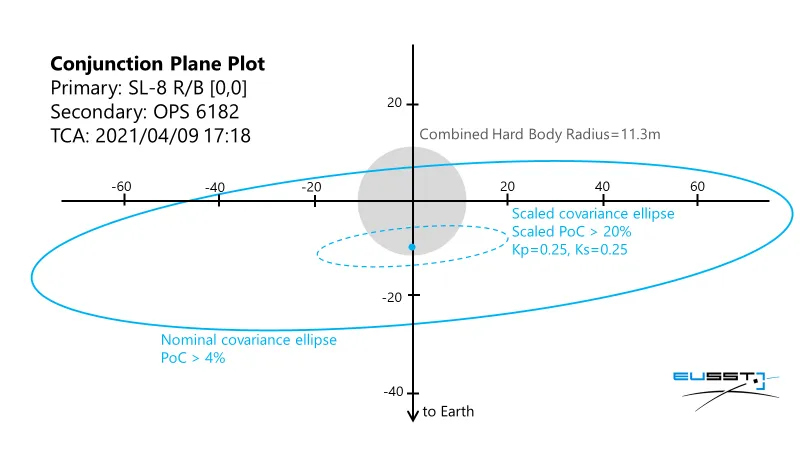
Update, 5:05 p.m. ET Friday (April 9): According to EUSST, both objects have been observed to still be intact after their brush with danger, suggesting they did not collide.
There's a one-in-five chance of two large satellites colliding at a relative velocity of 32,679 mph (52,592 km/h) over the Siberian Arctic Friday (April 9) — an event that would scatter 2.1 tons (1,900 kilograms) of debris across Earth's orbital space.
European Union Space Surveillance and Tracking (EUSST) first warned of the close approach between the two inactive satellites on Wednesday (April 7). Then on April 8, the tracking office warned that the two objects would pass within 33 feet (10 meters) of one another, with a 20% chance of colliding.
"EUSST simulations indicate that the potential collision between the two space objects would generate more than 4 million fragments," the agency tweeted at 4:05 a.m. ET April 9. "More than 400 of the fragments generated by the potential collision would be larger than 20 cm [8 inches]."
LeoLabs, a private firm, wrote on Twitter that it largely agrees with the EUSST warning. But it pegged the collision risk at 2% and estimated the pass distance at 144 feet (44 meters).
The two orbiting objects no longer work and cannot alter their orbits, which will meet at an altitude of 490 miles (790 kilometers).
Jonathan McDowell, a Harvard astronomer and spaceflight expert, wrote on Twitter that the larger of the two pieces of space junk is a 1.5 ton (1,400 kg) stage of a Soviet rocket used to loft a communications satellite into orbit in May 1981. The smaller object is a 1,100-pound (500 kg) American meteorological satellite, known as OPS 6182 (DMSP 5D-1 F2), which launched in May 1978.
Get the world’s most fascinating discoveries delivered straight to your inbox.
Related: Here's every spaceship that's ever carried an astronaut into orbit
Space debris collisions have been a growing threat in recent years as the number of satellites in space — including inoperable, defunct relics — grows dramatically. In January 2020, two different satellites came within feet of each other without colliding. At the time, astronomers? calculated they had a 1 in 20 chance of crashing into each other, Live Science reported. (They missed.)
Related:
Any new debris in space also poses a threat to active satellites and human spaceflight. Objects in orbit are moving very fast — many times the speed of a bullet — and even a small piece of debris hitting a critical weather satellite or spacecraft could be catastrophic.
The long-term risk, according to NASA, is that as debris accumulates in orbit, collisions that produce more debris become more likely. At some point, if the problem goes un-addressed, there could be a "chain reaction" in space that would essentially render low-Earth orbit too dangerous for machines or people — closing off humanity's access to and use of even the nearest parts of space for the foreseeable future. This phenomenon is known as "Kessler Syndrome."
According to EUSST, the two objects will either skirt past each other or collide at 1:18 p.m. ET today. It should be clear shortly thereafter whether a disaster happened.
Originally published on Live Science.
