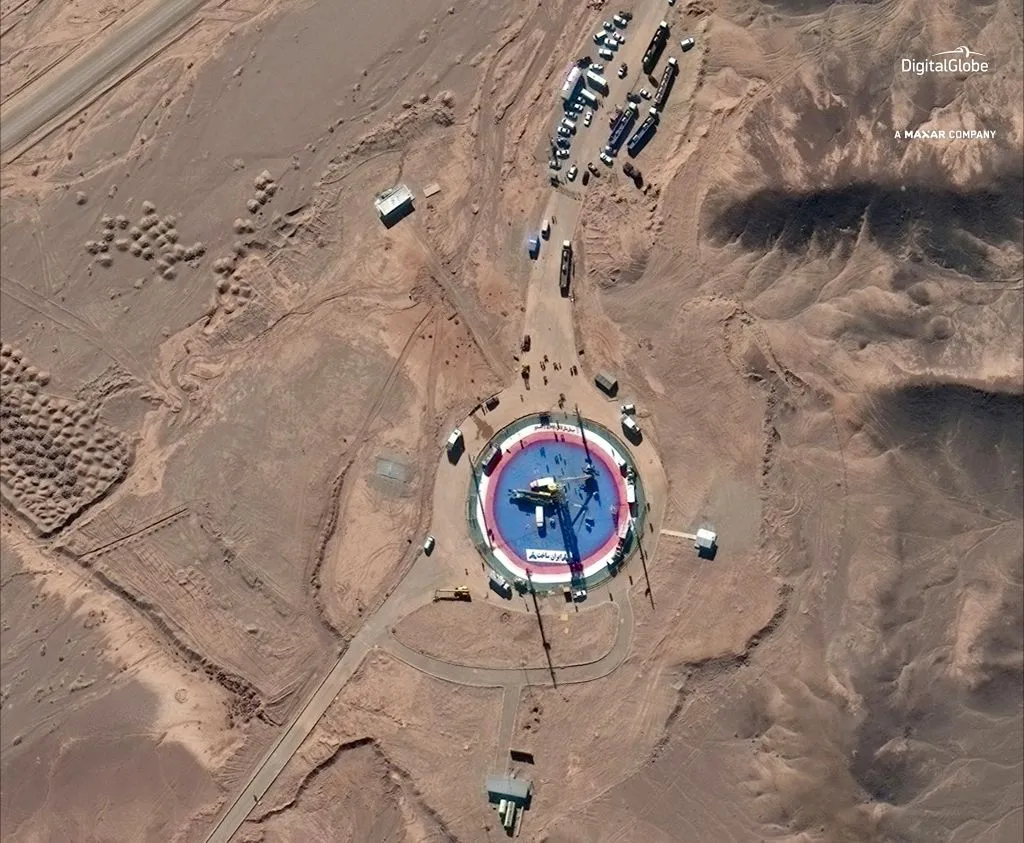
This photo by a satellite operated by DigitalGlobe, a subsidiary of Maxar Technologies, shows Iran's Imam Khomeini Space Center on Feb. 5, 2019, shortly before a Safir rocket launch that was later determined to be a failure.
(Image credit: Satellite image Copyright 2019 DigitalGlobe, a Maxar company)
Iran's space program suffered another setback on Sunday (Feb. 9).
The nation launched a communications satellite called Zafar 1 atop a Simorgh rocket at 10:45 a.m. EST Sunday (1545 GMT; 7:15 p.m. local time) from Imam Khomeini Space Center in northern Iran, the Associated Press reported. But Zafar 1 didn't make it all the way to orbit.
"Stage-1 and stage-2 motors of the carrier functioned properly and the satellite was successfully detached from its carrier, but at the end of its path it did not reach the required speed for being put in the orbit," Defense Ministry space program spokesman Ahmad Hosseini told Iranian state television, according to the AP.
The failure is not an isolated incident. Iran suffered a Simorgh launch failure in January 2019 and another one with a different rocket, the Safir, a month later. And, in August of last year, a rocket apparently exploded on the pad at Imam Khomeini Space Center, spawning smoke and wreckage that was spotted from space, by satellites operated by San Francisco-based company Planet.
Still, Iranian officials put on a brave face following Sunday's events.
"Today 'Zafar' satellite launch failed. Like many scientific projects, Failure happened. FALCON 9, Juno II, ATLAS, PROTON M, ANTARES are just few samples of US launch failures. But We're UNSTOPPABLE! We have more Upcoming Great Iranian Satellites!" Mohammad Javad Azari Jahromi, Iran's information and communications technology minister, said via Twitter on Sunday.
Sign up for the Live Science daily newsletter now
Get the world’s most fascinating discoveries delivered straight to your inbox.
Today "Zafar" satellite launch failed. Like many scientific projects, Failure happened. FALCON 9, Juno II, ATLAS, PROTON M, ANTARES are just few samples of US launch failures.But We're UNSTOPPABLE! We have more Upcoming Great Iranian Satellites! 🛰February 9, 2020
Tensions between the United States and Iran have been higher than usual lately. A U.S. drone strike killed high-ranking Iranian general Qasem Soleimani in early January. A few days later, Iran retaliated with missile strikes on several sites in Iraq that housed American troops. Nobody was killed in those strikes, American officials have said, though dozens of service members suffered concussions from the blasts.
Mike Wall's book about the search for alien life, "Out There" (Grand Central Publishing, 2018; illustrated byKarl Tate), is out now. Follow him on Twitter @michaeldwall. Follow us on Twitter@Spacedotcom orFacebook.
Michael was a science writer for the Idaho National Laboratory and has been an intern at Wired.com, The Salinas Californian newspaper, and the SLAC National Accelerator Laboratory. He has also worked as a herpetologist and wildlife biologist. He has a Ph.D. in evolutionary biology from the University of Sydney, Australia, a bachelor's degree from the University of Arizona, and a graduate certificate in science writing from the University of California, Santa Cruz.