 Live Science Plus





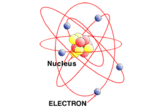
Since 1947, physicists have thought the neutron, an electrically neutral elementary particle and a primary component of an atom, actually carries a positive charge at its center and an offsetting negative charge at its outer edge.
But new research shows the setup is more complex.
"Nobody realized this was the case," said Gerald A. Miller, a University of Washington physicist. "It is significant because it is a clear fact of nature that we didn't know before. Now we know it."
The discovery changes scientific understanding of how neutrons interact with negatively charged electrons and positively charged protons. Specifically, it has implications for understanding the strong force, one of the four fundamental forces of nature (the others are the weak force, electromagnetism and the weakest of all—gravity).
The strong force binds atomic nuclei together, which makes it possible for atoms, the building blocks of all matter, to assemble into molecules.
"We have to understand exactly how the strong force works, because it is the strongest force we know in the universe," Miller said.
The findings are based on data collected at the Thomas Jefferson National Accelerator Facility in Newport News, Va., the Bates Linear Accelerator at the Massachusetts Institute of Technology and the Mainz Microtron at Johannes Gutenberg University in Germany.
The three labs examine various aspects of the properties and behavior of subatomic particles, and Miller studied data they collected about neutrons. His analysis was published online Sept. 13 in Physical Review Letters. The work was funded in part by the U.S. Department of Energy.
Since the analysis is based on data gathered from direct observations, the picture could change even more as more data are collected, Miller said.
"A particle can be electrically neutral and still have properties related to charge. We've known for a long time that the neutron has those properties, but now we understand them more clearly," he said.

