













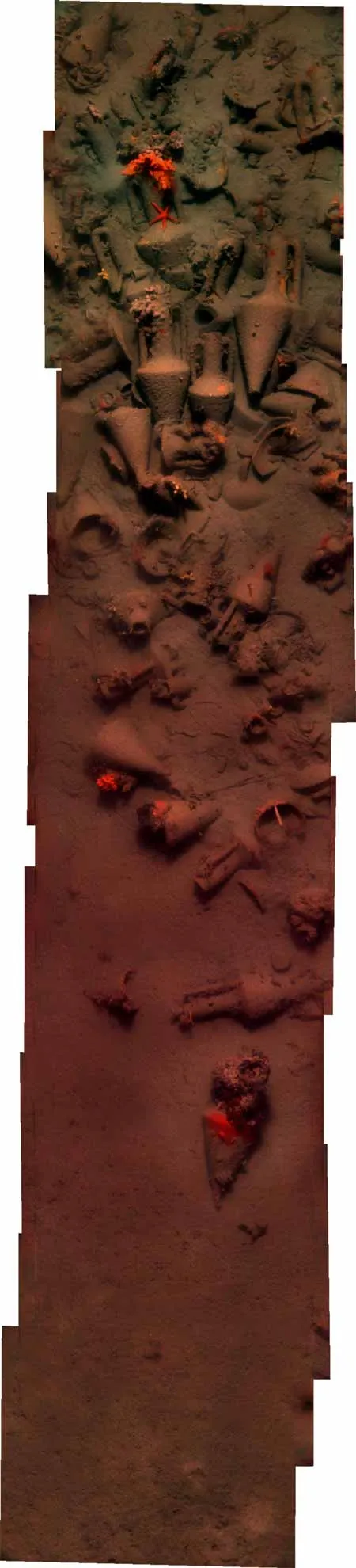
The remains of an ancient Greek cargo ship that sank more than 2,300 years ago have been uncovered with a deep-sea robot, archaeologists announced today.
The ship was carrying hundreds of ceramic jars of wine and olive oil and went down off Chios and the Oinoussai islands in the eastern Aegean Sea sometime around 350 B.C.
Archeologists speculate that a fire or rough weather may have sunk the ship. The wreckage was found submerged beneath 200 feet (60 meters) of water.
The researchers hope that the shipwreck will provide clues about the trade network that existed between the ancient Greek and their trading partners.
The wreck is "like a buried UPS truck," said David Mindell of the Massachusetts Institute of Technology (MIT). "It provides a wealth of information that helps us figure out networks based on the contents of the truck."
The shipwreck was located using sonar scans performed by the Greek Ministry of Culture in 2004. In July of 2005, researchers returned to the site with the underwater robot, called SeaBed.
The robot scanned the shipwreck and scattered cargo and created a topographical sonar map of the region. It also took more than 7,500 images over of the site over the course of four dives. The researchers have assembled those images into a mosaic.
Get the world’s most fascinating discoveries delivered straight to your inbox.
The study of the Chios shipwreck is part of a 10-year project that aims to examine ancient trade in the Mediterranean during the Bronze age (2500-1200 B.C.). In particular, the project will focus on the Minoan and Mycenaean cultures and their trading partners.
The investigating team also includes researchers from the Woods Hole Oceanographic Institute (WHOI), the Greek Ministry of Culture and the Hellenic Centre for Marine Research (HCMR).
- How to Preserve a 460-Year-Old Shipwreck
- 21st Century Robot Searches for Pre-Historic Event
- Underwater First: Robot Crosses Gulf Stream
- Land of Homer's 'Odyssey' Said Found