













Einstein's Theory of General Relativity Just Survived a Massive Crash in Outer Space

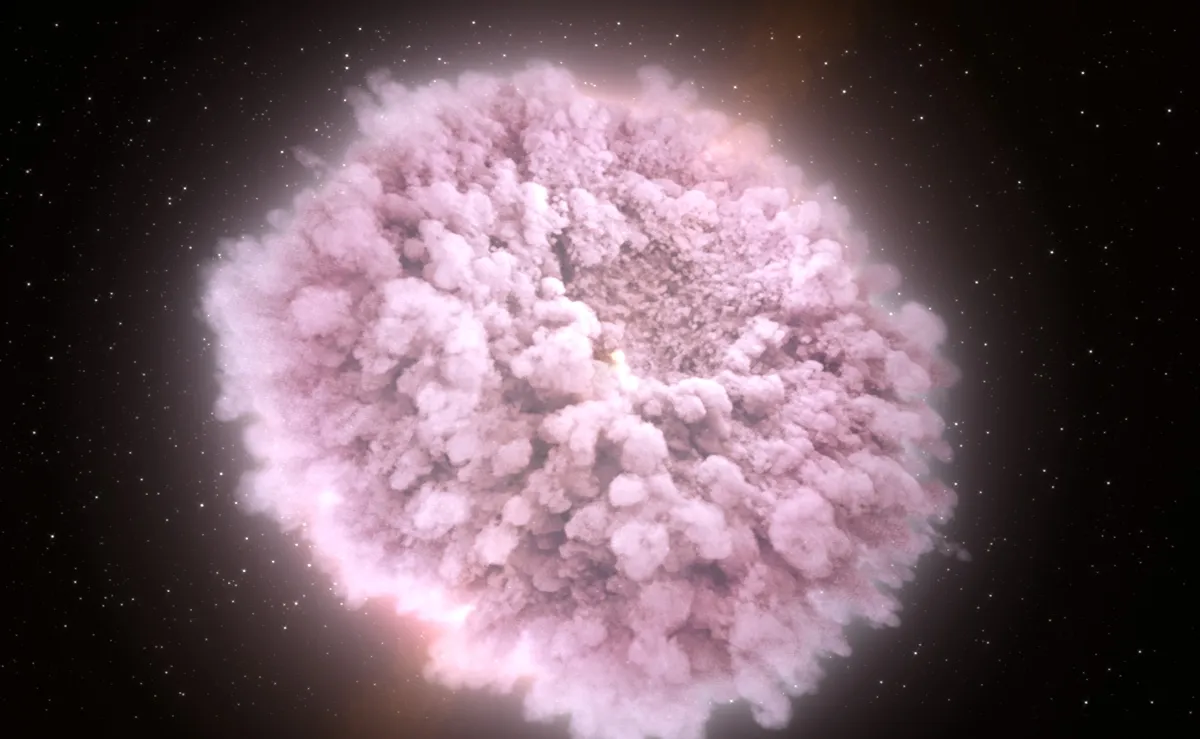
Gravity is big and weird and difficult to study. It moves through space as a wave, sort of like how light does. But these waves are subtle and difficult to detect. They occur in measurable amounts only after massive events, like the collision of black holes. Humanity didn't spot its first gravitational wave until 2015. Then, in 2017, astronomers for the first time detected both gravitational waves and light from a single event: a neutron star collision. Now, researchers are using data from that event to confirm some basic facts about the universe.
In a paper first uploaded Nov. 1 to the preprint server arXiv (which Live Science first saw reported on ScienceAlert), researchers announced that they found no evidence of "gravitational leakage." Scientists had thought it was possible for gravity to penetrate high dimensions (those beyond the four that humans experience — up/down, side to side, forward/backward, time) even though light does not. If that happened, the force of gravity would lose more of its energy than light does while passing through space. But comparing the light and gravitational waves from that neutron star collision showed that this wasn't happening.
All our dimension's gravity appears to be staying right where it belongs, as Albert Einstein predicted in his theory of general relativity.
The researchers in the new study also analyzed gravitational waves to see whether the graviton — the theoretical particle that carries gravity — might have mass, like other particles do. If there was such a thing as a "massive graviton," gravitational waves would also have mass, and if these waves had mass, they would exhibit signs of momentum, unlike light particles, which are massless. That would also be a violation of general relativity. But, again, it didn't happen.
Overall, researchers found, Einstein's theories of gravity remain basically intact. Someday, that might change. But it hasn't yet, even after two neutron stars slammed into each other.
- The 9 Biggest Unsolved Mysteries in Physics
- Album: The World's Most Beautiful Equations
- Beyond Higgs: 5 Elusive Particles That May Lurk in the Universe
Originally published on Live Science.
Get the world’s most fascinating discoveries delivered straight to your inbox.
