













Iconic Blue Whale at AMNH Gets a Scrubbing: How to Watch Live

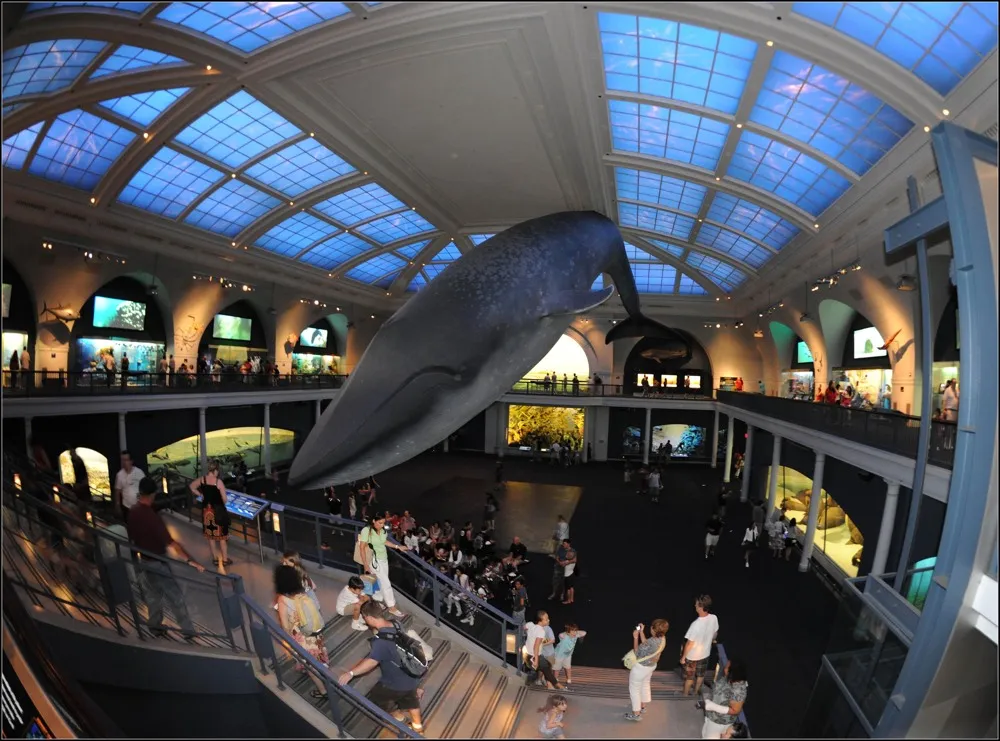
While blue whales don't have to worry too much about getting dusty, fiberglass models of blue whales that hang in museums aren't so lucky — which is why the American Museum of Natural History (AMNH) schedules annual cleaning sessions for the nearly-life-sized blue whale model that hangs serenely in the museum's Milstein Hall of Ocean Life.
Visitors to AMNH can take in the sight of this unusual bath-time in person, as the whale cleaners grab their tools and get to work today (Sept. 7) at 11:15 a.m. ET. And if you can't make it to the museum, you can watch the whole event live on Live Science.
At 21,000 pounds (9,525 kilograms) and 94 feet (29 meters) in length, the fiberglass whale won't be removed from its usual spot, suspended from the museum ceiling high over visitors' heads. Rather, members of the AMNH Exhibition department will ascend in a special lift to reach the whale, and then use vacuums and brushes to carefully remove the year's accumulation of dust from its head and body.
Originally installed in 1969, the sizable model was created from photographs taken in 1925, of a female blue whale that had been found dead off the southern tip of South America, according to a post on the AMNH website. The whale model received a makeover in 2001, with artists reshaping its body to more accurately resemble living blue whales — tapering its tail, flattening its bulging eyes, reshaping its blowholes and adding the missing belly button.
In 2001, museum artists also brightened the whale's color with shades of blue, which should be especially vibrant following the annual cleaning.
Original article on Live Science.
Get the world’s most fascinating discoveries delivered straight to your inbox.

Mindy Weisberger is a science journalist and author of "Rise of the Zombie Bugs: The Surprising Science of Parasitic Mind-Control" (Hopkins Press). She formerly edited for Scholastic and was a channel editor and senior writer for Live Science. She has reported on general science, covering climate change, paleontology, biology and space. Mindy studied film at Columbia University; prior to LS, she produced, wrote and directed media for the American Museum of Natural History in NYC. Her videos about dinosaurs, astrophysics, biodiversity and evolution appear in museums and science centers worldwide, earning awards such as the CINE Golden Eagle and the Communicator Award of Excellence. Her writing has also appeared in Scientific American, The Washington Post, How It Works Magazine and CNN.