













Mysterious Symbols in Kazakhstan: How Old Are They, Really?

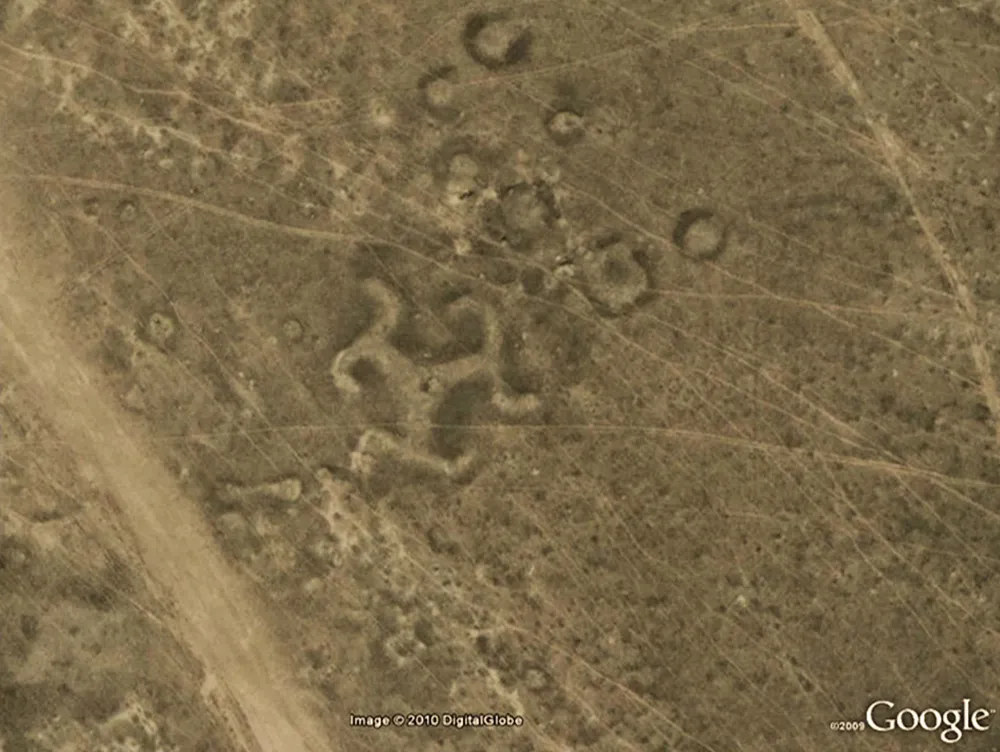
Sprawling earthen swastika designs, crosses and rings that cover part of Kazakhstan are becoming a little less mysterious: Archaeologists have found and investigated 60 of these symbols, called geoglyphs, and determined when they were created and what their potential function might have been.
The Kazakhstan geoglyphs, described at an archaeology conference in Istanbul and reported by Live Science last year, range in size from 90 to 400 meters (295 to 1,312 feet) across — longer than a commercial aircraft.
The earthen works take on various geometric shapes, including squares, crosses, rings and a swastika. In ancient times, the swastika was a common design with no political undertones. The geoglyphs were shaped from earth. [See Google Earth Images of the Sprawling Kazakhstan Geoglyphs]
Using a dating technique called optically stimulated luminescence (OSL), the archaeologists recently found that the structures were constructed starting around 2,800 years ago. They were built at the beginning of Kazakhstan's "iron age," when iron tools and weapons gradually replaced those made of bronze, said archaeologists Andrew Logvin and IrinaShevnina, both of Kostanay University in Kazakhstan.
The astronauts aboard the International Space Station may try to take images of the geoglyphs, Melissa Higgins, an earth science and remote sensing scientist at NASA, said in a phone conversation with Live Science. Whether the crew is able to take images depends on their schedule and whether sun elevation will allow them to capture photos of the geoglyphs, she said.
A New York Times report published on Oct. 30 suggested the geoglyphs (which the Times called "ancient earthworks") date as far back as 8,000 years — which would make them older than any other such geoglyphs, including the famous Nazca Lines of Peru, which date to between 200 B.C. and A.D. 500.
However, following the publication of that story, the three archaeologists who did the research — Logvin and Shevnina, as well as Giedre Motuzaite Matuzeviciute, a postdoctoral fellow at Vilnius University in Lithuania —disputed the report, saying the geoglyphs are not nearly that old.
Get the world’s most fascinating discoveries delivered straight to your inbox.
Live Science contacted all three of them last weekend, after the New York Times story was published, to find out if the date, and other details of the story, were accurate.
The claim that these symbols date back as far as 8,000 years is "not supported by any evidence at all," Matuzeviciute said. The OSL dating technique the team used "gave ca. 800 B.C. and nothing earlier," she said.
In the time since, The Times has made changes (compare the article before and after) to the story to clarify that the claim that the geoglyphs are 8,000 years old does not come from the archaeologists doing the research but rather from a "separate scholarly report linking artifacts from the Mahandzhar culture (7000 B.C. to 5000 B.C.) to other figures, suggesting a date as early as 8,000 years ago for the oldest." The Times does not specify who wrote this report or where it was published. The Times writer, in response to a Live Science inquiry, said he stands by the accuracy of the article.
So far, the archaeologists can confirm the existence of 60 such geoglyphs in Kazakhstan. They suspect more will be found, but they have yet to find 260 of the earthen designs, as was reported by the Times, Logvin and Shevnina said.
Though the purpose of the geoglyphs is not known, excavations at the geoglyphs have yielded the remains of structures and hearths that may have been used as sanctuaries, Logvin and Shevnina said. They also noted that the geoglyphs might have been used by tribes to mark territory.
Logvin and Shevnina said that, earlier this year, they received a grant from Kazakhstan's Ministry of Science that will aid in their research.
Editor's Note: This article was updated to state that all of the geoglyphs, including the swastika symbol, are made from earth.
Follow us@livescience, Facebook & Google+. Original article on Live Science.

Owen Jarus is a regular contributor to Live Science who writes about archaeology and humans' past. He has also written for The Independent (UK), The Canadian Press (CP) and The Associated Press (AP), among others. Owen has a bachelor of arts degree from the University of Toronto and a journalism degree from Ryerson University.