













As people ring in the New Year with dancing and a bit of bubbly, they can consider themselves part of an ancient human tradition.
Several new archaeological finds suggest that alcohol has been a social glue in parties, from work festivals to cultic feasts, since the dawn of civilization.
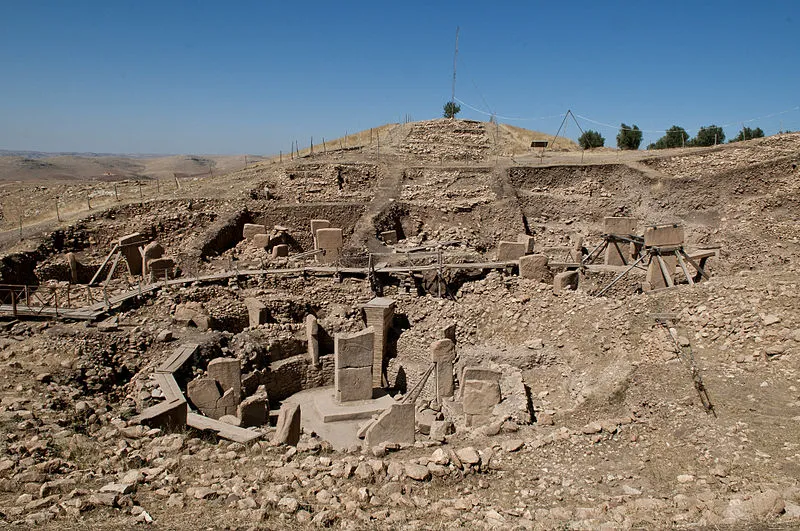
In the December issue of the journal Antiquity, archaeologists describe evidence of nearly 11,000-year-old beer brewing troughs at a cultic feasting site in Turkey called Göbekli Tepe. And archaeologists in Cyprus have unearthed the 3,500-year-old ruins of what may have been a primitive beer brewery and feasting hall at a site called Kissonerga-Skalia. The excavation, described in the November issue of the journal Levant, revealed several kilns that may have been used to dry malt before fermentation.
The findings suggest that alcohol has been a social lubricant for ages, said Lindy Crewe, an archaeologist at the University of Manchester, who co-authored the Levant paper.
For bread or beer?
While the cultivation of grain clearly transformed humanity, why it first happened has been hotly contested. [History's Most Overlooked Mysteries]
"This debate has been going on since the 1950's: Is the first cultivation of grain about making beer or is it about making bread?" Crewe said.
Get the world’s most fascinating discoveries delivered straight to your inbox.
Some researchers suggest that beer arose 11,500 years ago and drove the cultivation of grains. Because grains require so much hard work to produce (collecting tiny, mostly inedible parts, separating grain from chaff, and grinding into flour), beer brewing would have been reserved for feasts with important cultural purposes.
Those feasts — and alcohol-induced friendliness — may have enabled hunter-gatherers to bond with larger groups of people in newly emerging villages, fueling the rise of civilization. At work parties, beer may have motivated people to put a little elbow grease into bigger-scale projects such as building ancient monuments.
"Production and consumption of alcoholic beverages is an important factor in feasts facilitating the cohesion of social groups, and in the case of Göbekli Tepe, in organizing collective work," wrote Antiquity paper co-author Oliver Dietrich in an email. Dietrich is an archaeologist for the German Archaeological Institute.
Ancient party sites
The site in Cyprus includes a courtyard and hall, along with jugs, mortars and grinding tools, and crucially, several kilns that Crewe and her colleagues believe were used to toast barley for a primitive beer. To test their hypothesis the team replicated the kilns to produce malted barley and used it in a cloudy and slightly weird-tasting beer, Crewe told LiveScience.

The Göbekli Tepe site in southwestern Turkey, meanwhile, dates to nearly 11,000 years ago. Neolithic hunter-gatherers worshipped ancient deities through dancing and feasting at the temple site, which is filled with t-shaped pillars carved with animal shapes and other ancient cultic designs. The site also had what appears to be a primitive kitchen with large limestone troughs that held up to 42 gallons (160 liters) of liquid. The troughs held traces of oxalates, which are produced during the fermentation of grain into alcohol.
At both sites, the idea of a beer-soaked party must have been a real treat, Crewe said.
"There must have been a real sense of anticipation within the community when you knew a big beer event was coming up," she said.
Follow LiveScience on Twitter @livescience. We're also on Facebook &Google+.

Tia is the editor-in-chief (premium) and was formerly managing editor and senior writer for Live Science. Her work has appeared in Scientific American, Wired.com, Science News and other outlets. She holds a master's degree in bioengineering from the University of Washington, a graduate certificate in science writing from UC Santa Cruz and a bachelor's degree in mechanical engineering from the University of Texas at Austin. Tia was part of a team at the Milwaukee Journal Sentinel that published the Empty Cradles series on preterm births, which won multiple awards, including the 2012 Casey Medal for Meritorious Journalism.