













Surprise Found in Earth's Plumbing System

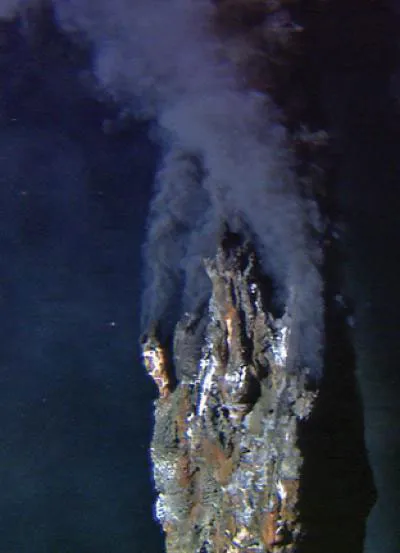
Seismologists have used tiny earthquakes to make the first images of the inside of a deep sea vent — and it doesn’t look like anyone thought it would.
Sea floor vents (often called "black smokers" because of the cloud of chemicals they ooze) are the outflow channels of vast plumbing systems that exist under the Earth's mid-ocean ridges, which run across some 37,000 miles (60,000 kilometers) of the seafloor.
Hydrothermal vents are found all over the globe.
The hypothetical image scientists had drawn of these vent systems had cold, deep-ocean water being forced down by overlying pressure through large faults along the ridges. The water was then thought to be superheated by shallow volcanism, eventually rising toward the middle of the ridges where the vents tend to be clustered.
But the new images, detailed in a study in the Jan. 10 issue of the journal Nature, paint a different picture: Ocean water appears to descend through tiny cracks in the ridge, instead of large faults, then runs below the ridge along its axis in a tunnel-like zone just above a magma chamber for several kilometers. As the water gets heated, it rises back to the sea floor (like a pot of boiling water) and bubbles out through a series of vents.
"If you google on images of hydrothermal vents, you come up with cartoons that don't at all match what we see," said lead study author Maya Tolstoy of the Lamont-Doherty Earth Observatory, a part of Columbia University.
The new images of the vent system, taken along the East Pacific Rise about 565 miles southwest of Acapulco, Mexico, were created using seismometers that recorded 7,000 tiny, shallow earthquakes over the course of seven months in 2003 and 2004.
Get the world’s most fascinating discoveries delivered straight to your inbox.
The quakes are thought to be the result of cold water passing through the hot rocks below the surface and picking up their heat, causing the rocks to cool and shrink, and therefore crack and create small tremors.
The new model also suggests that the water moves a lot faster that previously thought — perhaps a billion gallons per year flows through the particular system studied.
The findings could help scientists determine how the thriving communities around these vents travel along seafloor currents and how the nutrients that feed them flow.
- Video: Hydrothermal Vents
- Images: Under the Pacific
- 101 Amazing Earth Facts

Andrea Thompson is an associate editor at Scientific American, where she covers sustainability, energy and the environment. Prior to that, she was a senior writer covering climate science at Climate Central and a reporter and editor at Live Science, where she primarily covered Earth science and the environment. She holds a graduate degree in science health and environmental reporting from New York University, as well as a bachelor of science and and masters of science in atmospheric chemistry from the Georgia Institute of Technology.