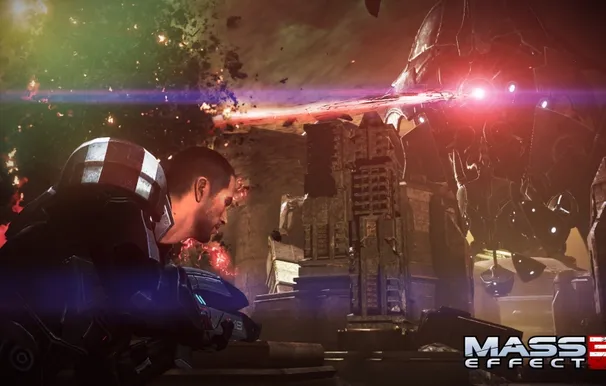
When Sir Arthur Conan Doyle killed off Sherlock Holmes in "The Final Problem" in 1893, grief-stricken readers took to London's streets wearing black armbands. More recently, "Star Wars" fans howled in outrage when George Lucas changed certain scenes in the Blu-ray release of the original film trilogy. Such storytelling controversies still can't compare to gamer fury over how the best-selling "Mass Effect" video games ended.
The "Mass Effect" games carry greater expectations than any book, film or TV series ever could. Such games liberate the audience from the usual tyranny of following a single, defined storyline — gamers play the starring role as Commander Shepard (male or female) in a science fiction universe where they can romance favorite companions and decide the fate of entire alien species. But in the final act, "Mass Effect 3" yanks away the freedom gamers have enjoyed over the 120 hours to 150 hours spent playing the "Mass Effect" trilogy.
"Players are upset because the big finish, the real 'end' to it all is definitely more general, and nearly entirely out of player control," said Lucas Siegel, editor of Newsarama (a sister website of InnovationNewsDaily). "After the hundreds of choices you make, there are only small differences in the end, and some things, the fates of certain parts of this world, are left open to interpretation, rather than being flat-out told."
"Mass Effect" fans did much more than just complain bitterly — they clamored to reclaim their storytelling freedom by demanding new story endings from the game creators at Bioware. The uproar finally led Bioware to make a surprise announcement on March 21 that it would create new game content to provide "more clarity for those seeking further closure to their journey."
Players can choose to play either a male or female Commander Shepard in the Mass Effect series of games.
(Image credit: Bioware)
The storyteller and the audience
Many media critics looked down their noses at "entitled" gamers for demanding new story endings, and similarly sniffed at Bioware for "caving in" to fan pressure rather than sticking with its artistic vision. But gamers have a right to feel entitled up to a point, Siegel said.
That's because video games such as "Mass Effect" represent a very different kind of storytelling from the books, films and TV shows that have dominated modern culture. Whereas readers receive the gospel of "Harry Potter" according to J.K. Rowling and moviegoers receive the gospel of "Star Wars" according to George Lucas, gamers stand alongside Bioware at the storytelling altar in shaping the "Mass Effect" plot.
Sign up for the Live Science daily newsletter now
Get the world’s most fascinating discoveries delivered straight to your inbox.
To its credit, Bioware has recognized that fact by showing enormous respect to "Mass Effect" fans, Siegel said.
"When speaking with Mac Walters, lead writer on "Mass Effect 3" and the plotter of the "Mass Effect" comics, he spoke of the big difference in writing the comics, where you simply tell the story, and the games, where the player is helping craft specifics as the greater narrative unfolds," Siegel told InnovationNewsDaily.
Such a balance of storytelling power simply does not exist for most books, films and TV shows. When fans complained about the endings to TV shows such as "Lost" or "The Sopranos," they never disputed the authority of the creators to decide those endings. Even when Doyle delighted fans a century ago by resurrecting Sherlock, he remained the authoritative storyteller for the great detective.
The Mass Effect games allow players to decide the fates of entire worlds or alien species.
(Image credit: Bioware)
The mutating story
By contrast, video game stories don't have to follow a singular vision defined by a master storyteller (although this naturally varies among games). Instead, the stories grow from the play experience — the choices made within games create personalized player performances.
"Because game performances are infinitely various, we have a situation where the emphasis is on the performance itself and on the variations," said Roger Travis, director of the Video Games and Human Values Initiative at the University of Connecticut.
Such performances resemble more ancient forms of oral storytelling such as telling improvised tales or re-enacting epic poems, Travis said. As a professor of classics, he pointed to how Homer's "The Iliad" and "The Odyssey" evolved as oral stories performed by Greek bards on a nightly basis.
Performing live rather than reading from a book or showing a film gave the bards the freedom to raise the possibility of many different story versions — not unlike how "Mass Effect" allows for alternate storylines to play out. "If the hero died in one version of the story on one night, he didn't have to die another night," Travis explained.
That fluid nature of oral storytelling also allowed the Greek bards to listen to audiences, other bards and patrons, and to reshape stories in response, Travis said. If critics want to criticize Bioware for "caving in" to fans, they might as well criticize Homer for having evolved the story of "The Iliad" and "The Odyssey" in response to audiences 2,500 years ago.
Gamer choices in Mass Effect can shape the story in dramatically different ways.
(Image credit: Bioware)
The return of story freedom
The "Mass Effect" controversy does not signal the death of artistic vision or storytelling authority, Travis said. But he suggested that new video game experiences may win over more people from the older, more static forms of storytelling.
"I think authored media will lose some of the prestige they've had as people expect to get more rewarding and interactive experiences from interactive media," Travis said. "But authored media will always have a place because we want to hear about some genius' vision."
Still, even the geniuses must prepare to face new audiences with ever-greater expectations for immersive storytelling that also gives freedom of choice.
"The fact that games of this generation (and only moreso in the future) can deliver cinema-quality storytelling and immersion while also giving consumers greater control than anywhere else completely changes not just expectations, but how creators have to approach narrative," Siegel said.
This story was provided by InnovationNewsDaily, a sister site to LiveScience. You can follow InnovationNewsDaily Senior Writer Jeremy Hsu on Twitter @ScienceHsu. Follow InnovationNewsDaily on Twitter @News_Innovation, or on Facebook.
Jeremy has written for publications such as Popular Science, Scientific American Mind and Reader's Digest Asia. He obtained his masters degree in science journalism from New York University, and completed his undergraduate education in the history and sociology of science at the University of Pennsylvania.